

I beg people not to accept the seasonal ritual of well-timed charity on Christmas Eve. It's blasphemy.
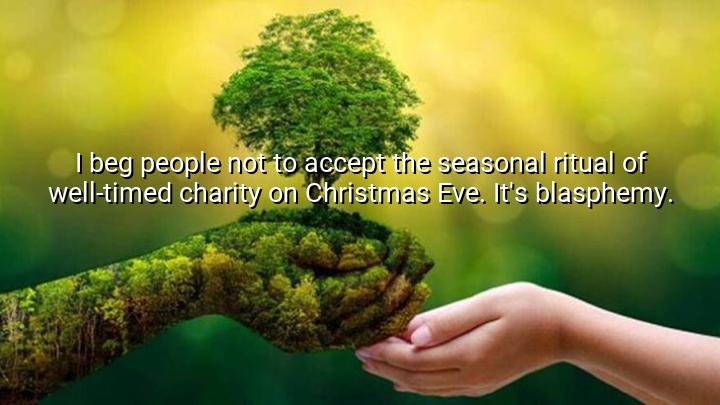




In this quote, Jonathan Kozol critiques the superficial nature of seasonal charity, particularly the well-meaning but often fleeting acts of giving that occur around Christmas Eve. Kozol argues that it is insufficient to perform charitable acts only during the holiday season, when such gestures can feel like a ritual rather than a genuine expression of compassion. He uses the word blasphemy to emphasize how the act of giving just for appearance’s sake goes against the true spirit of generosity and social responsibility that should be present year-round.
Kozol’s statement calls for a deeper, more sustained commitment to addressing the needs of the poor and marginalized, rather than merely satisfying a sense of guilt or fulfilling a societal expectation during the holidays. He challenges the idea that charity can be reduced to a once-a-year event, suggesting that true compassion requires continuous, year-round action, not just temporary or symbolic acts.
The term blasphemy is particularly powerful in this context, as it conveys Kozol’s belief that reducing charity to a seasonal ritual diminishes its true purpose. Charity, for Kozol, is a moral obligation, and treating it as something to check off a list during Christmas undermines its deeper significance as a tool for social change and justice. He advocates for a more authentic, meaningful approach to giving that goes beyond mere token gestures.
Ultimately, Kozol’s quote challenges us to think critically about the nature of charity and how we engage with social issues. It serves as a reminder that genuine compassion should not be confined to a particular season, but should be an ongoing, consistent effort to improve the lives of those in need.

AAdministratorAdministrator
Welcome, honored guests. Please leave a comment, we will respond soon