

I balanced all, brought all to mind, the years to come seemed waste of breath, a waste of breath the years behind, in balance with this life, this death.
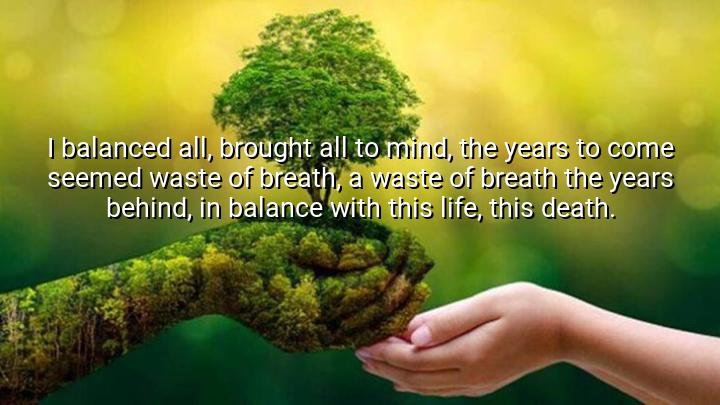




The quote "I balanced all, brought all to mind, the years to come seemed waste of breath, a waste of breath the years behind, in balance with this life, this death." by William Butler Yeats reflects a deep existential reflection on life, death, and the passage of time. Yeats, known for his poetic exploration of themes like mortality and the human condition, uses this quote to convey a sense of disillusionment or resignation toward both the past and the future. The phrase "the years to come seemed waste of breath" suggests that, after much contemplation, he feels that time and its progression may be futile or insignificant in the grand scheme of things.
The idea of balancing all refers to Yeats' contemplation of his life and death, evaluating both his past actions and future possibilities. This balance brings him to the realization that neither the years that have passed nor the years that lie ahead carry ultimate meaning in the context of his present existence. Yeats' focus on the balance between life and death suggests an acceptance that both are intertwined, and that life’s purpose may not lie in the distant past or the uncertain future, but in the moment he currently occupies.
Yeats' reflection on death in this context highlights his recognition of its inevitability. The phrase "this life, this death" indicates that, despite the passing years, he finds peace or equilibrium in accepting both as part of the same human experience. The notion of "waste of breath" conveys a sense of the fleeting nature of existence, and the feeling that efforts made throughout life may not ultimately result in lasting significance.
The origin of this quote lies in Yeats’ later works, particularly in his poetry surrounding aging and his evolving perspective on life and mortality. Written as part of his final phase, these lines reflect his spiritual and philosophical musings on the transient nature of time. Yeats often used his work to grapple with the complexities of existence, and this quote serves as a poignant meditation on the inevitable balance between life and death, a theme that is central to much of his poetry.

AAdministratorAdministrator
Welcome, honored guests. Please leave a comment, we will respond soon