

I am often amazed at how much more capability and enthusiasm for science there is among elementary school youngsters than among college students.
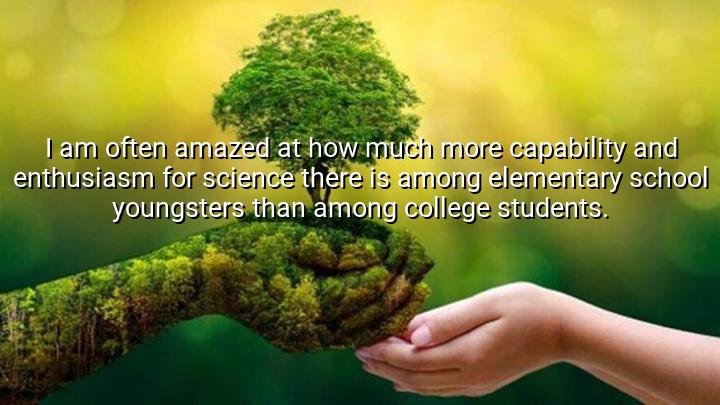




Carl Sagan’s quote reflects his belief in the natural curiosity and enthusiasm for learning that children often possess, especially when it comes to science. By saying, "I am often amazed at how much more capability and enthusiasm for science there is among elementary school youngsters than among college students," Sagan points out a surprising contrast between the openness and excitement that young children have for discovery and the more reserved or disengaged attitudes often found in older students. Children are typically eager to explore, ask questions, and engage with the world around them without fear of failure or judgment.
This statement highlights the idea that, as people grow older, they can become more self-conscious, disillusioned, or focused on external pressures like grades or career outcomes. In contrast, younger children approach science with freshness and an innate wonder, seeing it as a way to understand the world rather than a subject confined to textbooks and lectures. Sagan’s observation challenges the conventional notion that only more experienced or older students are capable of deep scientific thinking.
Sagan’s admiration for this youthful enthusiasm suggests a belief that curiosity is an essential aspect of scientific inquiry—and that it can sometimes be lost or stifled as students advance through the education system. He likely saw this shift as something to be reclaimed, where encouraging the same kind of excitement and open-mindedness in older students could fuel future breakthroughs in science and innovation.
The origin of this quote can be found in Carl Sagan’s role as a science communicator and educator, where he witnessed firsthand the differences in how students of various ages approached science. Sagan, known for his work in astronomy and popular science writing, often spoke about the importance of maintaining a sense of wonder and intellectual curiosity—a sentiment reflected in this observation about the contrasts between youthful excitement and adult complacency in learning.

AAdministratorAdministrator
Welcome, honored guests. Please leave a comment, we will respond soon