

I am not a woman on Monday, an immigrant on Tuesday, a worker on Wednesday, and a mom on Thursday, I am all of those things all of the time, and I am going to fight for all of those things all of the time.
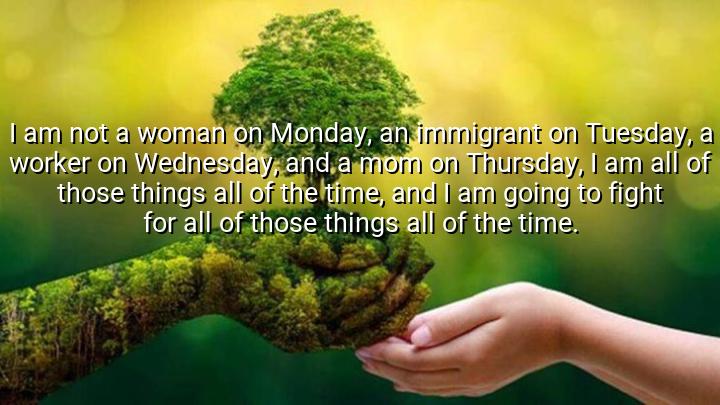




This quote by Pramila Jayapal, a prominent American politician and advocate for immigrant rights, speaks to the complex and multifaceted nature of identity and the fight for representation. By stating, "I am not a woman on Monday, an immigrant on Tuesday, a worker on Wednesday, and a mom on Thursday," Jayapal rejects the notion of being compartmentalized into separate roles. Instead, she asserts that these identities—woman, immigrant, worker, and mom—are all parts of who she is, and they coexist constantly. This highlights the intersectionality of her experience, where different aspects of her identity cannot be neatly separated or ignored.
The second part of the quote, "I am all of those things all of the time," emphasizes that identity is not fluid or interchangeable but integrated and constant. It challenges the conventional approach of viewing people through a single lens, suggesting that we are all a combination of overlapping roles and experiences. Jayapal's words call for a recognition of the complexity of individuals, particularly those who navigate multiple layers of identity due to factors like gender, immigration status, and social roles.
"I am going to fight for all of those things all of the time" expresses her unwavering commitment to advocating for justice and equality across all aspects of her life. It’s a call to action for constant advocacy for the rights of all individuals, particularly those who face marginalization or discrimination in various spheres of life. Jayapal's determination to fight for empowerment, social change, and representation reflects her political and personal ethos, where the fight for justice is unrelenting and multidimensional.
This quote is rooted in Jayapal’s own experience as a politician, immigrant, and activist who has spent much of her career fighting for the rights of immigrants, women, and marginalized communities. It reflects her belief that advocacy is not a temporary or episodic effort but a lifelong commitment to making change on all fronts, especially when it involves the intersectional struggles that many face daily.

AAdministratorAdministrator
Welcome, honored guests. Please leave a comment, we will respond soon