

I am a deeply religious nonbeliever - this is a somewhat new kind of religion.
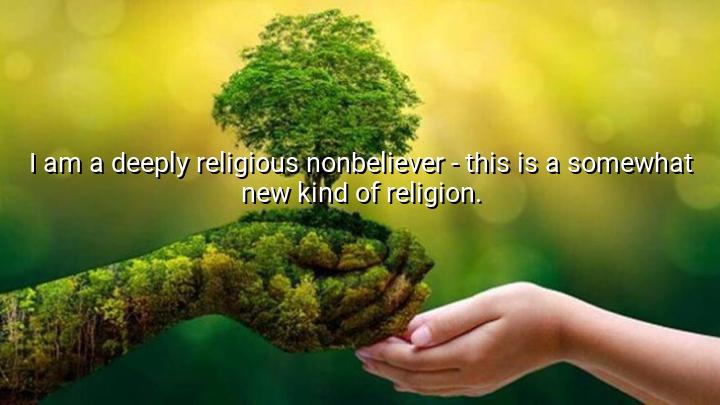




In this quote, Albert Einstein expresses a unique perspective on religion and spirituality. By calling himself a "deeply religious nonbeliever," he is acknowledging a profound sense of awe and reverence for the universe, yet rejecting the traditional concepts of God and organized religion. For Einstein, religion does not necessarily require belief in a personal deity or adherence to specific doctrines. Instead, his spirituality is rooted in a sense of wonder at the mystery and order of the natural world, which he believed could inspire a sense of reverence similar to religious faith.
Einstein's stance reflects a more philosophical and scientific approach to spirituality, where one can have a deep connection to the universe without subscribing to the dogmas of traditional religions. He often expressed his admiration for the laws of nature and how they could reveal the underlying order of existence. This idea aligns with his belief in the unity of the cosmos and the interconnectedness of all things, which he felt could evoke a spiritual experience, even without the need for religious rituals or deities.
The origin of this quote can be traced to Einstein’s personal philosophy, which blended his scientific understanding with a sense of mysticism and awe. Throughout his life, he wrestled with questions of faith and existence, famously stating that he did not believe in a personal God but had a deep sense of reverence for the mystery of the universe. He referred to his worldview as a form of religiosity based on curiosity, wonder, and an ethical commitment to humanity, rather than belief in supernatural forces. This rejection of traditional religious views while still maintaining a form of spirituality is what makes his perspective unique.
Ultimately, this quote highlights Einstein’s belief that spirituality and science are not mutually exclusive. He suggests that one can experience a deep connection to the universe and its mysteries, even without adhering to the teachings of traditional religions. This new kind of religion embraces intellectual and emotional engagement with the world, seeing the pursuit of knowledge and understanding as a form of reverence in itself. It’s a reminder that spirituality can be deeply personal and can exist alongside a rational approach to life and the cosmos.

AAdministratorAdministrator
Welcome, honored guests. Please leave a comment, we will respond soon