

I always thought we had an environmental problem, but I hadn't realized how urgent it was. James Lovelock writes that by the end of this century there will be one billion people left.
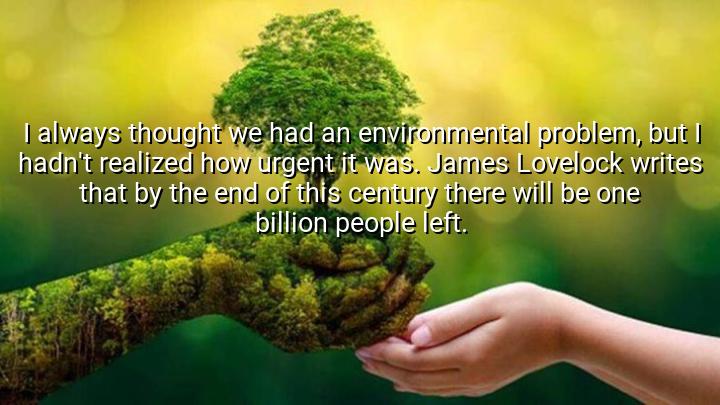




In this quote, Vivienne Westwood expresses a shift in her understanding of the environmental problem, recognizing not only its existence but its urgency. Initially, she was aware of the environmental challenges facing the planet, but she had not fully grasped the gravity of the situation. Westwood refers to the work of James Lovelock, who predicted a catastrophic future where, by the end of the century, only one billion people might remain due to the devastating effects of environmental destruction. This stark prediction underscores the severity of the crisis.
Westwood’s statement highlights a growing realization that the environmental crisis is not something that can be addressed in the distant future, but rather is a present-day issue with imminent consequences. The mention of Lovelock’s forecast serves to intensify the sense of urgency, stressing that the survival of the planet and humanity is at a critical juncture. This reflects the need for immediate action to mitigate the effects of climate change, pollution, and resource depletion.
The origin of this quote comes from Westwood’s long-standing commitment to environmental activism and sustainability. Known for her work as a fashion designer, Westwood has used her platform to raise awareness about environmental issues and advocate for changes in consumption and production. Her engagement with Lovelock's ideas indicates her deepening understanding of the climate crisis and her growing concern about the future of the planet.
Ultimately, Westwood’s quote serves as a wake-up call, urging individuals and governments to take immediate action to address the environmental challenges we face. It reflects the growing acknowledgment that climate change and ecological destruction are not just abstract concepts, but urgent crises with profound implications for future generations.

AAdministratorAdministrator
Welcome, honored guests. Please leave a comment, we will respond soon