

Humans aren't as good as we should be in our capacity to empathize with feelings and thoughts of others, be they humans or other animals on Earth. So maybe part of our formal education should be training in empathy. Imagine how different the world would be if, in fact, that were 'reading, writing, arithmetic, empathy.'
Humans aren't as good as we
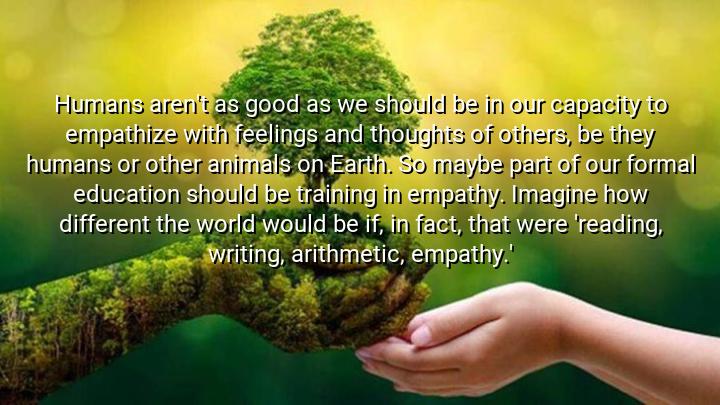
Humans aren't as good as we should be in our capacity to empathize with feelings and thoughts of others, be they humans or other animals on Earth. So maybe part of our formal education should be training in empathy. Imagine how different the world would be if, in fact, that were 'reading, writing, arithmetic, empathy.'

Humans aren't as good as we
Humans aren't as good as we should be in our capacity to empathize with feelings and thoughts of others, be they humans or other animals on Earth. So maybe part of our formal education should be training in empathy. Imagine how different the world would be if, in fact, that were 'reading, writing, arithmetic, empathy.'
Humans aren't as good as we
Humans aren't as good as we should be in our capacity to empathize with feelings and thoughts of others, be they humans or other animals on Earth. So maybe part of our formal education should be training in empathy. Imagine how different the world would be if, in fact, that were 'reading, writing, arithmetic, empathy.'
Humans aren't as good as we
Humans aren't as good as we should be in our capacity to empathize with feelings and thoughts of others, be they humans or other animals on Earth. So maybe part of our formal education should be training in empathy. Imagine how different the world would be if, in fact, that were 'reading, writing, arithmetic, empathy.'
Humans aren't as good as we
Humans aren't as good as we should be in our capacity to empathize with feelings and thoughts of others, be they humans or other animals on Earth. So maybe part of our formal education should be training in empathy. Imagine how different the world would be if, in fact, that were 'reading, writing, arithmetic, empathy.'
Humans aren't as good as we

The quote by Neil deGrasse Tyson emphasizes the importance of empathy in human development and education. Tyson points out that humans often fall short in their ability to understand and connect with the feelings and thoughts of others, whether they are humans or other animals. He suggests that cultivating empathy should be an essential part of formal education, alongside traditional subjects like reading, writing, and arithmetic.

Tyson envisions a world in which education prioritizes emotional intelligence as much as cognitive skills. By training individuals to empathize, society could foster greater compassion, understanding, and cooperation. Such a curriculum would encourage students to consider the impact of their actions on others, promoting a more ethical, inclusive, and humane society.

The origin of this quote comes from Neil deGrasse Tyson, an astrophysicist and science communicator known for advocating the public understanding of science and education. While he is primarily associated with the sciences, Tyson often emphasizes the broader role of education in shaping responsible, thoughtful, and empathetic citizens.

In essence, Tyson’s quote underscores that true education goes beyond intellectual achievement. By integrating empathy into the learning process, individuals can develop not only knowledge but also moral insight, enabling them to engage more thoughtfully with the world and all its inhabitants.

Neil deGrasse Tyson
Neil deGrasse Tyson

American - Scientist Born: October 5, 1958

Have 0 Comment Humans aren't as good as we

AAdministratorAdministrator

Welcome, honored guests. Please leave a comment, we will respond soon

Reply.
Information sender
Leave the question
Click here to rate
Information sender
0.33713 sec| 2560.797 kb