

Human spirit is the ability to face the uncertainty of the future with curiosity and optimism. It is the belief that problems can be solved, differences resolved. It is a type of confidence. And it is fragile. It can be blackened by fear and superstition.
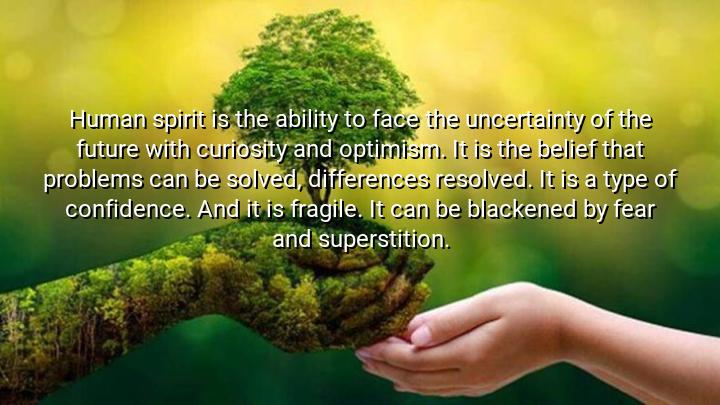




The quote "Human spirit is the ability to face the uncertainty of the future with curiosity and optimism. It is the belief that problems can be solved, differences resolved. It is a type of confidence. And it is fragile. It can be blackened by fear and superstition." is attributed to Bernard Beckett, a New Zealand author and playwright known for his thought-provoking works on philosophy, science, and human nature. This quote appears in his dystopian novel Genesis, which explores deep questions about identity, free will, and the essence of humanity through a futuristic lens.
At its core, the quote defines the human spirit as a resilient yet vulnerable force. It’s our ability to confront the unknown with curiosity, seek solutions to problems, and believe in the possibility of peace and understanding. This perspective portrays the human spirit as a form of hopeful confidence—a trait that drives innovation, empathy, and collaboration in the face of challenges.
However, Beckett also highlights the fragility of this spirit. Though powerful, it can be easily dimmed or “blackened” by fear, superstition, and irrational beliefs. These darker forces can erode our sense of agency and openness, leading to division, stagnation, and despair. Beckett warns that the very qualities that define our humanity must be consciously protected and nurtured.
Ultimately, this quote serves as both a tribute and a caution. It celebrates the strength of the human spirit but also reminds us that it must be defended against forces that seek to diminish it. Beckett’s message resonates strongly in times of uncertainty, urging us to choose hope, reason, and curiosity over fear and ignorance.

AAdministratorAdministrator
Welcome, honored guests. Please leave a comment, we will respond soon