

Human beings are accustomed to think of intellect as the power of having and controlling ideas and of ability to learn as synonymous with ability to have ideas. But learning by having ideas is really one of the rare and isolated events in nature.
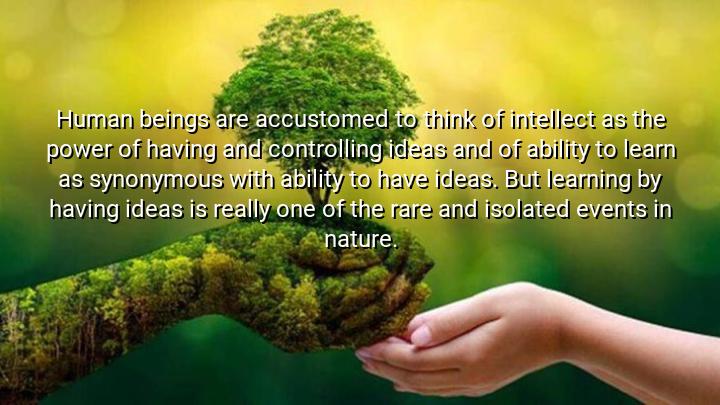




In this quote, Edward Thorndike challenges the traditional view of intellect and learning. He points out that people often equate intellect with the power of having and controlling ideas, and that learning is thought to be synonymous with the ability to generate those ideas. Thorndike, however, argues that learning by having ideas is actually a rare and isolated event in nature, suggesting that the process of learning is far more complex and diverse than simply having ideas or concepts.
Thorndike's statement invites a broader understanding of learning as not only about ideas, but also about experiences, observation, and practice. His perspective highlights the role of behavioral learning, where acquiring knowledge often involves more than intellectual engagement—it may also involve trial and error, sensory input, and the shaping of responses through experience. This challenges the idea that simply generating ideas leads to genuine learning, emphasizing that intellectual growth often stems from interacting with the world and adjusting based on those interactions.
The origin of this quote comes from Edward Thorndike, a prominent psychologist known for his work in educational psychology and the study of learning theory. He was a pioneer in behaviorism and believed that learning was more about forming associations through stimuli and responses rather than abstract thinking alone. His work laid the foundation for later developments in learning theory, including the idea of trial-and-error learning and instrumental conditioning.
Ultimately, Thorndike’s quote encourages us to reconsider how we define learning and intelligence. By recognizing that learning goes beyond merely having ideas, it invites a more holistic view of intellectual development, one that incorporates the role of experience, action, and interaction with the environment in shaping knowledge. This perspective urges a shift away from seeing learning as just a mental process and highlights its connection to real-world experiences and behaviors.

AAdministratorAdministrator
Welcome, honored guests. Please leave a comment, we will respond soon