

From the lowest animals of which we can affirm intelligence up to man this type of intellect is found.
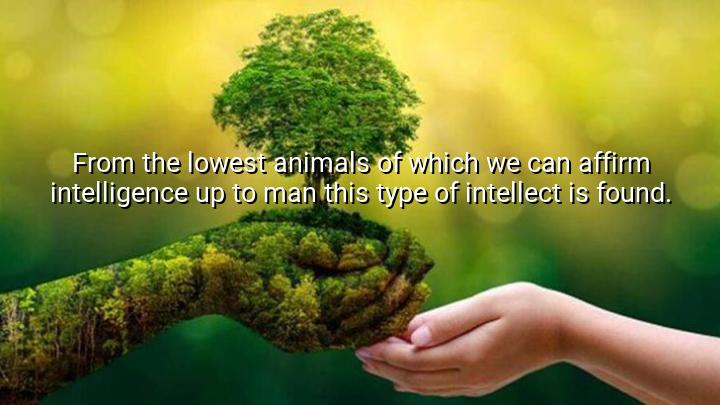




The quote by Edward Thorndike, "From the lowest animals of which we can affirm intelligence up to man this type of intellect is found," reflects Thorndike's view on the continuity of intelligence across species. He suggests that the ability to reason, solve problems, and adapt to the environment is not unique to humans but is present to varying degrees in the animal kingdom. Thorndike's statement emphasizes the idea that intellect is a spectrum, with animals exhibiting different levels of cognitive abilities that reflect a developmental progression toward the more complex intellectual capacities seen in humans.
In this context, Thorndike is challenging the traditional view that intelligence is something that exists only in humans or is somehow entirely distinct from that of other creatures. Instead, he suggests that intelligence can be observed in animals, and even though it may be less advanced than in humans, it still shares certain fundamental traits. This idea aligns with Thorndike's work in psychology and his development of the law of effect, which demonstrated how animals and humans alike learn from consequences and rewards.
The origin of this quote comes from Edward Thorndike, a prominent psychologist and educational theorist known for his pioneering studies on animal behavior and the learning process. His research, particularly with cats and other animals, was foundational in understanding the cognitive processes of non-human species. Thorndike’s work contributed significantly to the development of behaviorism and laid the groundwork for modern learning theory.
Ultimately, Thorndike's quote underscores the idea that intelligence is a natural trait that spans across species, varying in complexity but present in all forms of life. His words challenge us to reconsider the human-centric view of intellect and recognize the shared cognitive abilities that connect us to the rest of the animal world. This idea encourages further exploration of how different species experience and process the world around them.

AAdministratorAdministrator
Welcome, honored guests. Please leave a comment, we will respond soon