

He who knows no hardships will know no hardihood. He who faces no calamity will need no courage. Mysterious though it is, the characteristics in human nature which we love best grow in a soil with a strong mixture of troubles.
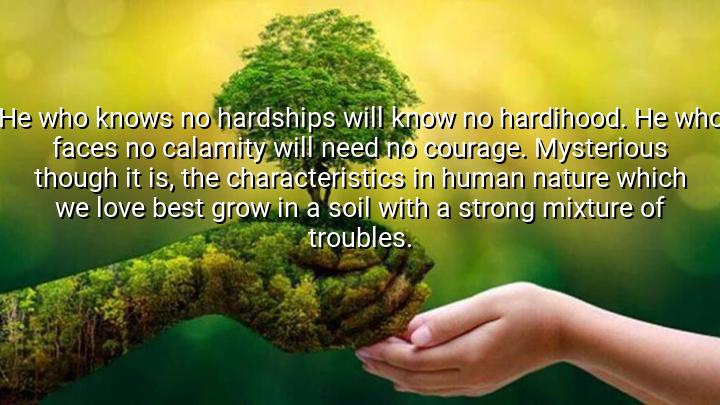




In this quote, Harry Emerson Fosdick reflects on the idea that hardship and calamity are essential for developing key virtues like hardihood and courage. Fosdick suggests that individuals who are sheltered from difficulties may never truly experience the growth that comes from facing adversity. Without encountering challenges, one cannot develop the inner strength and bravery needed to overcome them, because such traits are cultivated through the trials of life.
Fosdick goes on to say that the characteristics of human nature that are most admirable, such as resilience, bravery, and determination, are often born in the midst of difficulties. These qualities don't emerge in times of ease or comfort, but rather in moments when people are tested by troubles. The metaphor of soil implies that just as plants grow stronger in rich, challenging environments, human virtues also thrive in the "soil" of struggle and adversity.
The quote challenges the common perception that hardship should be avoided at all costs. Instead, Fosdick argues that troubles can be beneficial, as they force individuals to dig deep within themselves and develop qualities that might otherwise remain dormant. It is through these difficult experiences that we are often forced to confront our weaknesses, build resilience, and become more courageous.
Ultimately, Fosdick’s words suggest that adversity, while painful, is a crucial element of personal growth. The hardships and calamities we face shape us into stronger, more courageous individuals, capable of handling future challenges. These experiences allow us to discover the full depth of our character, making us more capable of navigating life with strength and grit.

AAdministratorAdministrator
Welcome, honored guests. Please leave a comment, we will respond soon