

Having known war I know the value of peace. Having lived under government control I know the value of freedom. Having lived with hatred, terror and corruption I know the value of faith and forgiveness.
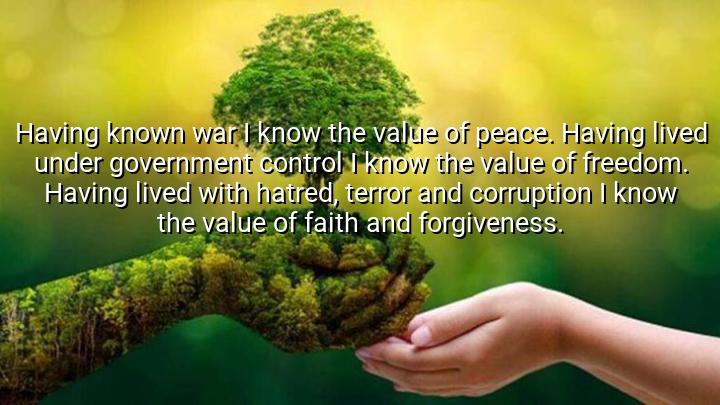




The quote by Phan Thi Kim Phuc expresses profound insights drawn from her personal experiences with war, government control, and hatred. Having known war, she deeply appreciates the value of peace, recognizing it as a precious and fragile state that contrasts starkly with the destruction and suffering caused by conflict. This highlights how firsthand exposure to violence can deepen one’s understanding of peace’s true worth.
Phuc also reflects on having lived under government control, which has shaped her appreciation for freedom. Experiencing restrictions on personal liberties gives her a unique perspective on the importance of freedom as a fundamental human right. Her words convey the significance of autonomy and the ability to live without oppression.
Additionally, Phuc speaks to the power of faith and forgiveness after enduring hatred, terror, and corruption. These experiences have taught her that spiritual strength and the willingness to forgive are vital tools for healing and moving forward. Her reflections underscore the transformative potential of faith and forgiveness in overcoming trauma and pain.
The origin of this quote is Phan Thi Kim Phuc, famously known as the “Napalm Girl” from the Vietnam War, who survived a napalm attack and later became a symbol of peace and reconciliation. Her life story embodies the profound lessons of valuing peace, freedom, faith, and forgiveness that arise from enduring unimaginable hardship.
In summary, Phuc’s quote conveys that experiencing war, control, and hatred profoundly shapes one’s understanding of peace, freedom, faith, and forgiveness, reminding us of the deep human capacity to find hope and strength in adversity.

AAdministratorAdministrator
Welcome, honored guests. Please leave a comment, we will respond soon