

Have an earnestness for death and you will have life.
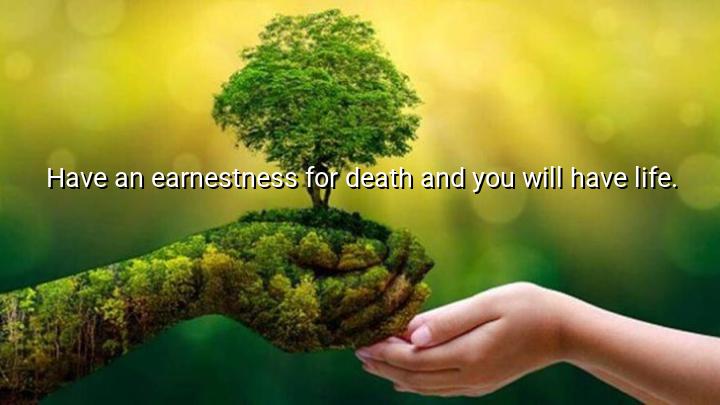




The quote "Have an earnestness for death and you will have life" by Abu Bakr, the first caliph of Islam and companion of the Prophet Muhammad, conveys a profound spiritual message about the relationship between life and mortality. Bakr suggests that by acknowledging and embracing the inevitable reality of death, one can live with greater purpose and clarity. This perspective encourages individuals to live life more fully, knowing that it is finite, and therefore, every moment should be valued and lived with intention.
Bakr’s words suggest that death is not something to be feared, but rather something that can bring meaning to life. When people become aware of the certainty of death, they are more likely to focus on what truly matters, such as their spiritual growth, relationships, and contributions to the world. By keeping death in mind, individuals are encouraged to live more mindfully and to prioritize actions that reflect their deepest values.
The origin of this quote comes from Islamic teachings, where reflection on death is a common theme. In Islamic philosophy, acknowledging mortality is believed to inspire individuals to lead lives of righteousness and devotion, knowing that they will eventually face an eternal afterlife. Abu Bakr’s perspective reflects this principle, suggesting that it is through understanding the transience of life that one can attain true fulfillment and peace.
Ultimately, Abu Bakr’s quote teaches that the contemplation of death should not be seen as morbid or depressing but as a tool for spiritual awakening and a deeper appreciation of life. By having an earnestness for death, people are encouraged to live more intentionally, recognizing the fleeting nature of life and seizing the opportunity to make the most of it. The awareness of death, in this view, is a source of wisdom and growth.

AAdministratorAdministrator
Welcome, honored guests. Please leave a comment, we will respond soon