

Happiness is just another of the tricks that our genetic system plays on us to carry out its only role, which is the survival of the species.
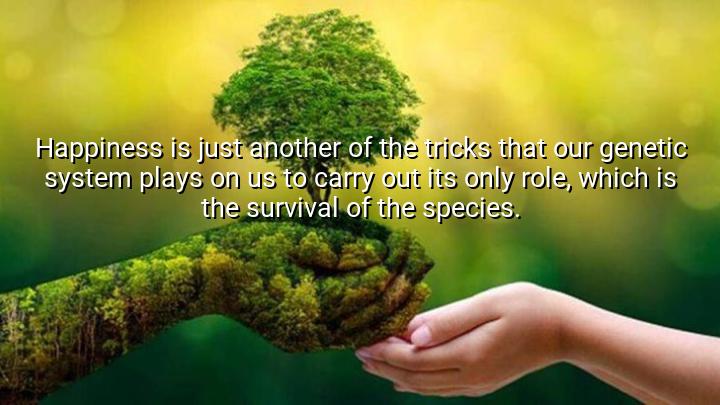




Paulo Coelho’s quote, "Happiness is just another of the tricks that our genetic system plays on us to carry out its only role, which is the survival of the species," suggests a biological perspective on the nature of happiness. Coelho proposes that what we perceive as happiness may not be an intrinsic or purely emotional experience but rather a mechanism designed by our genetic system to ensure the continuation of the human race. This viewpoint aligns with evolutionary biology, which posits that emotions like happiness are the result of evolutionary processes that serve the survival and reproduction of the species.
The idea that happiness is a "trick" implies that it may not be an end in itself, but rather a tool to encourage behaviors that support the survival of humans, such as procreation, social bonding, and cooperation. By feeling happy, we are more likely to engage in activities that benefit the community and promote the passing of our genes to the next generation. This view suggests that happiness, rather than being a purely personal or spiritual goal, has a biological purpose in the grand scheme of human existence.
Coelho’s statement highlights the tension between biological imperatives and personal experiences. While many people seek happiness for its own sake, Coelho challenges this conventional view by suggesting that the pursuit of happiness may actually be a biological instinct driven by the need to preserve and propagate the species. This raises questions about the true nature of human desires and whether they are truly our own or shaped by evolutionary forces.
The origin of this quote lies in Coelho’s broader philosophical and spiritual writings. Known for his exploration of the human condition and existential themes, Coelho often blends spirituality with psychological and biological insights. His work, especially in books like The Alchemist, examines the deeper motivations behind human actions and desires, and this quote reflects his belief in the complex forces—both internal and external—that shape human behavior.

AAdministratorAdministrator
Welcome, honored guests. Please leave a comment, we will respond soon