

Happiness is a mystery, like religion, and should never be rationalised.
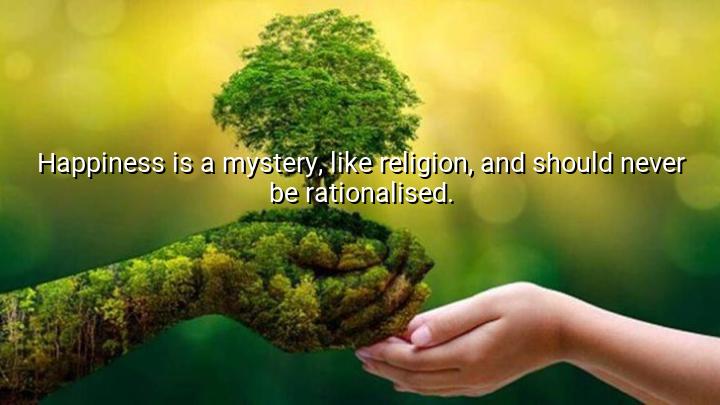




The quote by Gilbert K. Chesterton, "Happiness is a mystery, like religion, and should never be rationalised," suggests that happiness is an inherently elusive and personal experience that cannot be fully explained or understood through logic or reasoning. Chesterton compares happiness to religion, both of which are deeply subjective and transcend simple explanations. Just as religion involves faith, belief, and mysticism, happiness too is an aspect of life that cannot be reduced to a set of formulas or rational explanations.
Chesterton’s assertion is a challenge to those who try to overanalyze or quantify happiness. In an age where people often seek to explain every emotion or state of being through scientific reasoning or philosophical analysis, Chesterton suggests that there is something inherently mysterious and spiritual about happiness that cannot be pinned down. Instead of trying to define it, we should accept it as something to be experienced and appreciated in its natural form.
The idea of mystery in the quote also points to the concept that happiness is unique to each individual. Just as there are different ways people experience and practice religion, there are countless paths to happiness, and no two journeys are the same. By saying that it should never be rationalized, Chesterton is advocating for the acceptance of happiness as a complex and personal emotion, not something that can be fully understood or standardized.
In essence, Chesterton's quote invites us to embrace the mystery of happiness and religion without attempting to dissect them with rigid logic. Instead of seeking to rationalize or explain away these feelings, we should recognize their value in their pure, unexplainable form. Both happiness and religion, in this view, are meant to be experienced as wonder rather than analyzed.

AAdministratorAdministrator
Welcome, honored guests. Please leave a comment, we will respond soon