

Grant that the true organ with which the beautiful is apprehended is the imagination, and it follows that all arts are likely to affect the feelings indirectly.
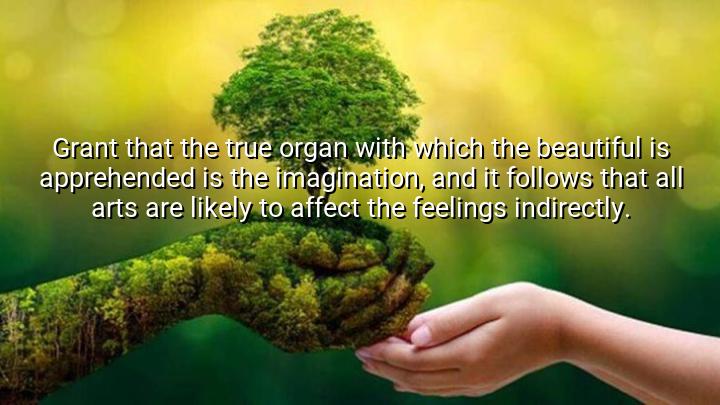




In this quote, Eduard Hanslick asserts that the imagination is the true organ through which we perceive and appreciate the beautiful. He suggests that beauty is not directly understood through sensory experience alone but is filtered through the imaginative faculty of the mind. This implies that beauty, whether in art, music, or nature, is experienced through a mental and emotional process, not just through physical observation.
Hanslick goes on to explain that because beauty is apprehended through the imagination, the impact of the arts is likely to affect the feelings indirectly. Instead of immediately evoking a direct, physical reaction, art works through the emotions and thoughts of the viewer or listener. The connection between the artwork and the audience is mediated by the mind, which interprets the beauty in a way that stirs deeper emotional responses.
This idea aligns with Hanslick's broader philosophy, particularly in relation to music. He was known for advocating a non-programmatic approach to music, arguing that music's power lies in its ability to convey emotion through form and structure, rather than through external narrative or imagery. According to this view, the emotional effect of art is not the result of direct manipulation of the senses but of the way the imagination processes the aesthetic experience.
Ultimately, Hanslick’s quote highlights the essential role of imagination in appreciating beauty and understanding the emotional impact of art. It suggests that art does not simply act on the senses; it engages the mind and feelings, creating a deeper, more complex connection with the viewer or listener. By recognizing this process, Hanslick elevates the importance of the imagination as a key component in how we experience and interpret the world around us.

AAdministratorAdministrator
Welcome, honored guests. Please leave a comment, we will respond soon