

God is dead. God remains dead. And we have killed him. Yet his shadow still looms. How shall we comfort ourselves, the murderers of all murderers? What was holiest and mightiest of all that the world has yet owned has bled to death under our knives; who will wipe this blood off us? What water is there for us to clean ourselves?
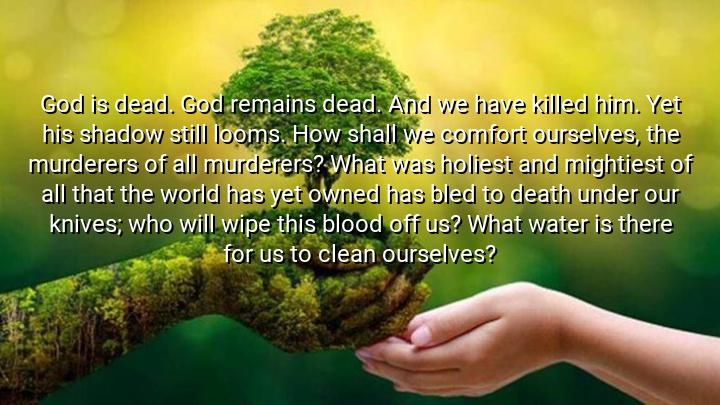




Friedrich Nietzsche’s quote, "God is dead. God remains dead. And we have killed him. Yet his shadow still looms," is one of the most famous and provocative statements in modern philosophy. Nietzsche uses the metaphor of the death of God to describe the decline of religious faith and the shifting of values in Western society. By saying that “God is dead,” Nietzsche doesn’t mean the literal death of a deity, but rather the collapse of the traditional belief system that had provided meaning, moral guidance, and structure to life. The "shadow" of God’s death refers to the lingering influence of religious and moral values that continue to shape society, even after belief in God has waned.
The second part of the quote, "How shall we comfort ourselves, the murderers of all murderers?" reflects Nietzsche’s profound existential crisis and the responsibility humanity faces in the absence of a central guiding force like religion. Without the authority of God, humans must confront the reality of creating meaning and values on their own, a challenge that brings uncertainty, despair, and even guilt. Nietzsche’s use of the word "murderers" emphasizes the radical break with traditional religious beliefs and the burden that comes with rejecting such foundational structures.
The quote further explores the consequences of this shift in values. "What was holiest and mightiest of all that the world has yet owned has bled to death under our knives" highlights the enormity of what has been lost with the decline of religious faith and the sense of purpose that came with it. Nietzsche’s words capture the existential weight of the loss of a moral compass, and the struggle to find meaning in a world without the certainties of religion. The rhetorical question, "who will wipe this blood off us?" points to the difficulty of healing from the moral crisis that results from the death of God.
The origin of this quote comes from Nietzsche’s work The Gay Science, published in 1882, where he first introduces the concept of the death of God. Nietzsche, a German philosopher, was deeply critical of traditional Christianity and metaphysical views that he believed limited human potential and growth. This quote is part of his larger critique of religion, and it underscores the philosophical and psychological challenges humanity faces as it grapples with the absence of divine authority and must create its own meaning in an increasingly secular world.

AAdministratorAdministrator
Welcome, honored guests. Please leave a comment, we will respond soon