

God is a thought who makes crooked all that is straight.
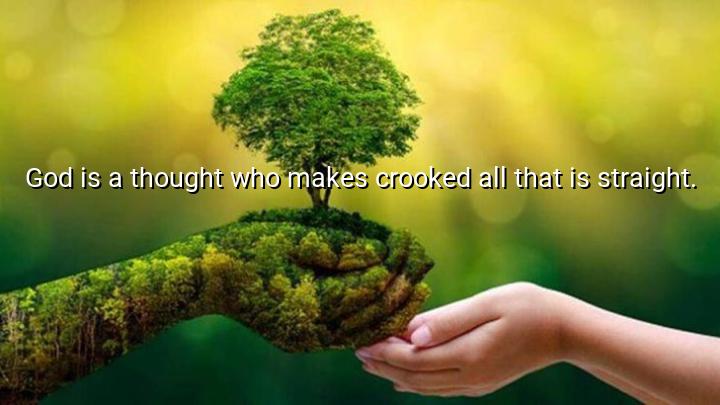




The quote "God is a thought who makes crooked all that is straight" by Friedrich Nietzsche reflects his critical and often provocative view of religion and divinity. Nietzsche suggests that the concept of God, particularly in the traditional, theistic sense, has a distorting effect on human thought and morality. In his philosophy, Nietzsche believed that religion, especially Christianity, often imposes unnatural or contradictory ideas about life, goodness, and truth. Rather than fostering a clear, rational understanding of the world, the idea of God, according to Nietzsche, leads people to accept illogical or twisted interpretations of life, where what is straightforward becomes unnecessarily complicated or distorted.
In this context, the phrase "makes crooked all that is straight" can be interpreted as Nietzsche’s assertion that divine or religious beliefs often corrupt human understanding and moral clarity. Nietzsche was a fierce critic of the metaphysical and otherworldly focus of religious traditions, which, in his view, detracted from the natural and human aspects of life. By personifying God as a thought, Nietzsche implies that the very idea of God, rather than being a concrete reality, is a mental construct that skews people's ability to see the world as it truly is, without the distortions of dogma or faith.
This quote is part of Nietzsche’s broader philosophy found in works like Thus Spoke Zarathustra and The Antichrist, where he explores the idea that traditional religion represses human creativity, freedom, and authenticity. Nietzsche saw religious concepts as limiting human potential, making people more dependent on external authorities and moral systems instead of trusting their own instincts and reason. His famous proclamation that “God is dead” encapsulates his belief that the traditional notion of God no longer held relevance in a modern, rational world.
Ultimately, Nietzsche’s quote invites us to question the influence of religious thought on our perceptions of morality and truth. It challenges us to reconsider how spiritual beliefs may impact our understanding of the world, urging us to seek clarity and rationality rather than blindly adhering to constructs that may distort our vision. In doing so, Nietzsche advocates for a philosophy that embraces individual empowerment, reason, and a rejection of external authority in shaping human life and values.

AAdministratorAdministrator
Welcome, honored guests. Please leave a comment, we will respond soon