

Generally speaking, a howling wilderness does not howl: it is the imagination of the traveler that does the howling.
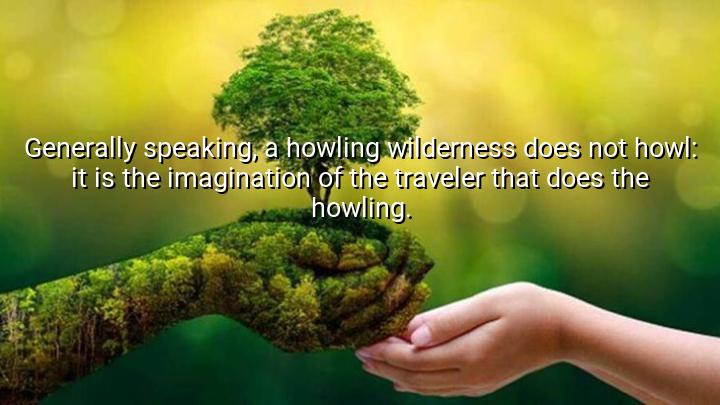




The quote "Generally speaking, a howling wilderness does not howl: it is the imagination of the traveler that does the howling" by Henry David Thoreau explores the relationship between perception and reality. Thoreau suggests that the often-feared, wild, and untamed nature of a wilderness is not inherently threatening or chaotic. Instead, it is the imagination of the traveler—their fears, expectations, and perceptions—that creates the illusion of a hostile environment. The wilderness itself may be silent and still, but the way it is interpreted can turn it into something far more dramatic.
Thoreau’s origin for this insight comes from his own experiences in nature, particularly his time living in the woods at Walden Pond. His philosophy emphasized self-reflection, the simplicity of nature, and how human beings often project their internal states onto the external world. In this context, he suggests that much of the fear or awe that people feel in unfamiliar, wild places is a result of their own imagination, which amplifies the unknown into something far more menacing than it may actually be.
In this quote, Thoreau challenges the notion that nature is inherently wild or threatening. The idea of a howling wilderness is not an objective fact about the environment, but a subjective creation of the traveler’s mind. The imagination plays a central role in how we experience the world, coloring our perceptions with our personal emotions, biases, and expectations. By understanding this, Thoreau invites us to reconsider our assumptions and confront the wilderness—or any unknown or intimidating aspect of life—with a more rational, balanced perspective.
Ultimately, Thoreau’s quote highlights the power of the imagination in shaping our experiences. While nature, in its purest form, may be neutral and unremarkable, our mental framework can transform it into something more vivid or intimidating. This serves as a reminder of how our imagination can both create and distort reality, influencing our responses to the world around us.

AAdministratorAdministrator
Welcome, honored guests. Please leave a comment, we will respond soon