

Gardeners instinctively know that flowers and plants are a continuum and that the wheel of garden history will always be coming full circle.
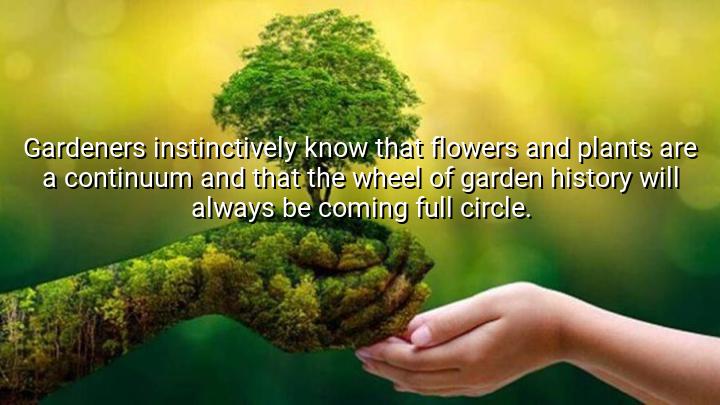




Francis Cabot Lowell’s quote reflects the natural continuity of gardening, emphasizing that flowers and plants are part of an ongoing cycle. He suggests that gardeners intuitively understand the interconnectedness of nature, where each element—whether it’s a plant, a season, or a gardening practice—forms part of a larger continuum. The idea that the "wheel of garden history will always be coming full circle" conveys that gardening practices and plant life are constantly evolving yet often return to earlier traditions, creating a cyclical pattern.
Lowell’s reference to the "wheel of garden history" also highlights the timelessness of gardening as an art. Despite new trends, technologies, and discoveries, gardening, at its core, remains rooted in principles that gardeners have understood for centuries. This reflects the idea that each garden, while unique, is part of a much larger tradition of horticulture that spans generations, where old ideas are often rediscovered and reinterpreted in new ways.
The quote also emphasizes that gardening is not just about cultivation but about understanding the deeper relationship between nature and humanity. Gardeners, according to Lowell, are aware that their work is part of something much bigger than themselves, contributing to the ongoing story of the garden as a living, breathing entity. This perspective encourages a more holistic view of gardening, where one’s efforts are seen as part of an eternal cycle of growth, decay, and renewal.
The origin of this quote stems from Francis Cabot Lowell’s deep engagement with gardening and horticulture, particularly his role in the creation of historic gardens. As an influential figure in the development of American gardens and landscapes, Lowell was attuned to the cyclical nature of gardening practices. His reflection on the continuum of garden history emphasizes the importance of both preserving traditional gardening knowledge and embracing the inevitable evolution that comes with time.

AAdministratorAdministrator
Welcome, honored guests. Please leave a comment, we will respond soon