

From too much love of living, From hope and fear set free, We thank with brief thanksgiving Whatever gods may be That no life lives for ever; That dead men rise up never; That even the weariest river Winds somewhere safe to sea.
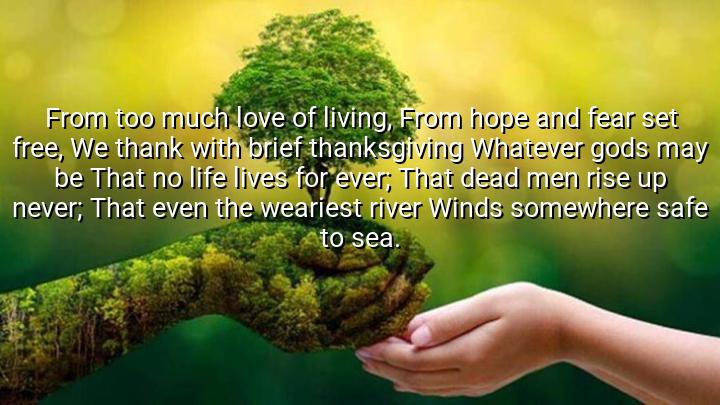




The quote is an excerpt from the poem “Revenge” by Algernon Charles Swinburne, a Victorian-era English poet known for his passionate, often controversial themes and mastery of rhythm and language. This particular passage reflects on the fragility of life, the interplay of hope and fear, and the inevitability of death. Swinburne’s poetry frequently grapples with complex emotions and philosophical questions about existence, mortality, and the human condition.
In these lines, Swinburne expresses a bittersweet gratitude that life is finite. The phrase “From too much love of living” captures a deep appreciation for life’s beauty and intensity, while “From hope and fear set free” suggests liberation from the anxieties that come with longing and uncertainty. The poet offers “brief thanksgiving” to whatever divine forces may exist, acknowledging a mysterious higher power while maintaining a skeptical or agnostic tone.
The reflection that “no life lives for ever” and “dead men rise up never” conveys an acceptance of mortality and finality. This stark reality, rather than causing despair, is seen as a form of release. Swinburne finds solace in the natural imagery of the “weariest river” that “winds somewhere safe to sea,” symbolizing a peaceful end to life’s struggles and a return to a greater whole.
Ultimately, the poem—and this quote—explores the tension between the love of life and the inevitability of death, suggesting that awareness of life’s transience enhances its value. Swinburne’s lyrical meditation invites readers to appreciate the fleeting moments of existence while finding comfort in the natural cycle of endings and renewal.

AAdministratorAdministrator
Welcome, honored guests. Please leave a comment, we will respond soon