

From my rotting body, flowers shall grow and I am in them and that is eternity.
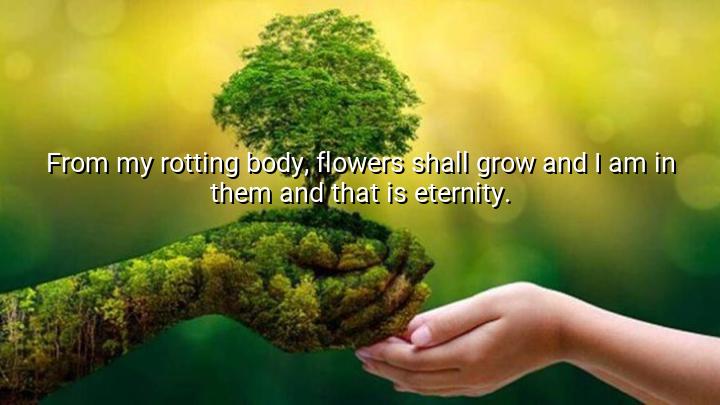




In this quote, Edvard Munch, the Norwegian painter famous for his iconic work The Scream, reflects on the concept of eternity through the metaphor of death and rebirth. He suggests that from his rotting body, symbolizing death, flowers will grow, representing life and growth. This cyclical process of decay and regeneration embodies the idea that even in death, there is a continuation and a transformation into something new. For Munch, this growth of flowers symbolizes a form of immortality and the connection between life and death.
The phrase "I am in them and that is eternity" expresses Munch’s belief that death does not mark the end of existence but rather a transition into a different form of being. His connection to the flowers is a representation of how his essence, or the impact of his life, continues to endure through nature. In this way, he sees eternity not as a static state but as something that is continuously reborn and renewed through the cycle of life and nature.
This perspective reflects Munch’s often philosophical and existential views on life, death, and the human condition. Throughout his work, Munch explored themes of anxiety, isolation, and the fragility of life, but he also found solace in the idea of transformation and the enduring presence of life, even after death. His quote emphasizes how the physical body may decay, but the spirit or impact of an individual can live on in the natural world and through the memories and legacies left behind.
Ultimately, Munch’s words invite a reflection on the interconnectedness of life and death. They suggest that eternity is not about an afterlife but about the ongoing cycles of life, growth, and renewal that continue beyond an individual’s physical existence. Through nature, art, and memory, a form of immortality can be achieved, and in that, Munch finds his sense of eternal presence.

AAdministratorAdministrator
Welcome, honored guests. Please leave a comment, we will respond soon