

From a planning perspective, economic degradation begets environmental degradation, which begets social degradation.
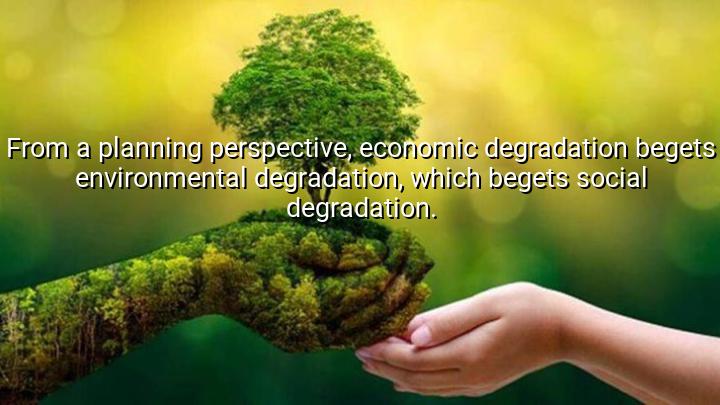




Majora Carter’s quote highlights the interconnected nature of economic, environmental, and social degradation. She argues that economic degradation—such as poverty or lack of access to resources—leads to environmental degradation, like pollution and resource depletion. In turn, the negative environmental impacts cause social degradation, which could include poor health, weakened communities, and increased inequality. Carter’s statement emphasizes that these issues are not isolated but are part of a cyclical process, where one form of degradation feeds into another, creating a vicious cycle that can be difficult to break.
The origin of this quote comes from Carter’s work as an urban revitalization expert and environmental justice advocate. She has spent much of her career addressing the disparities in underdeveloped communities, particularly those in urban environments, where economic and environmental challenges are often intertwined. Carter’s experience in both economic development and environmental activism led her to understand how these areas are closely linked, and how addressing them in isolation often fails to solve the underlying problems.
Carter’s statement calls for a holistic approach to solving these issues, suggesting that in order to break the cycle, we need to address economic inequality, environmental sustainability, and social well-being simultaneously. This approach recognizes that economic opportunities are necessary to create environmental change, and that improving the environment can help foster better social conditions. Rather than treating each area separately, Carter argues that planning should take into account the interconnectedness of all three.
Ultimately, Carter’s quote underscores the need for integrated solutions that address the root causes of social, economic, and environmental challenges. By recognizing that these issues are interconnected, we can work towards building sustainable and equitable communities where economic growth does not come at the expense of the environment, and where social and economic justice can thrive together.

AAdministratorAdministrator
Welcome, honored guests. Please leave a comment, we will respond soon