

Friendship is almost always the union of a part of one mind with the part of another; people are friends in spots.
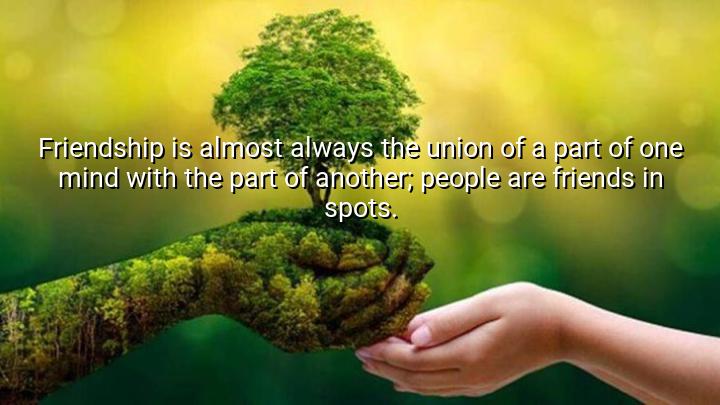




In this quote, George Santayana suggests that friendship is not a complete fusion of two people, but rather a union of specific aspects or parts of their individual minds. He implies that people are friends not because they are alike in every way, but because certain aspects of their personalities, interests, or values connect or resonate with each other. Friendships, in this sense, are not all-encompassing but rather occur in specific spots—areas where individuals' minds intersect.
Santayana's statement highlights the idea that friendships are often based on shared experiences or common interests, but they may not extend to every area of life. It suggests that people can form strong bonds in certain contexts, but those bonds may not extend to every aspect of their personality or behavior. This means that friendships can be partial and selective, with only certain parts of a person being compatible with another.
The origin of this viewpoint likely stems from Santayana’s broader philosophical ideas, which often explored the complexity of human nature and relationships. He was interested in how individuals relate to each other in various ways, acknowledging the limited and often selective nature of those connections. His understanding of friendship reflects a more realistic view, recognizing that not every aspect of two people’s lives needs to align for them to form a meaningful relationship.
Ultimately, Santayana's quote suggests that friendship is more nuanced and fragmented than we might think. Rather than expecting complete compatibility, it encourages us to appreciate the specific connections that make certain friendships meaningful, even if they only exist in certain areas of life.

AAdministratorAdministrator
Welcome, honored guests. Please leave a comment, we will respond soon