

Forgiveness is a spiritual practice and biblical mandate from the New Testament that many American Christians engage in as a part of their faith.
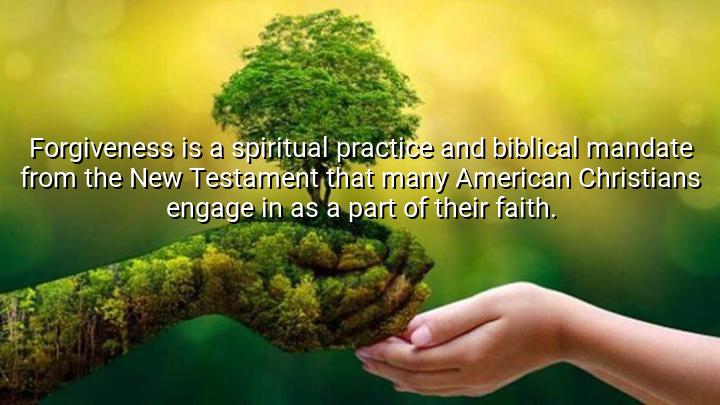




Anthea Butler’s quote underscores the idea that forgiveness is not just a moral or emotional act, but also a spiritual practice deeply rooted in Christian faith, particularly as prescribed in the New Testament. She suggests that for many American Christians, engaging in forgiveness is a key component of their religious practice—a way to align themselves with the teachings of Jesus and the principles of Christianity. In this context, forgiveness is not only a personal decision but also a mandate from the Bible, something that Christians are encouraged to live out as part of their spiritual journey.
The origin of this quote comes from Butler’s work as a scholar and historian of religion, particularly focusing on the intersection of faith and social issues in the United States. Her insights into the role of forgiveness in Christian life reflect her understanding of how religious practices shape individual behavior and collective identity within American culture. She highlights how forgiveness is woven into the fabric of Christian teaching and how it functions as a guiding principle for believers.
Butler’s reference to biblical mandate points to numerous teachings in the New Testament, such as Jesus' command to forgive others as God has forgiven them. In passages like Matthew 6:14-15, believers are encouraged to offer forgiveness to others as a reflection of God’s grace and mercy. For many Christians, practicing forgiveness is thus not just a recommendation but a divine obligation that reflects their commitment to living out the core values of love, compassion, and reconciliation.
Ultimately, Butler’s quote emphasizes the importance of forgiveness in Christian theology and its role in the everyday lives of believers. By framing forgiveness as both a spiritual practice and a biblical mandate, she highlights how integral this value is to the Christian faith and its impact on individual and communal relationships within the church and beyond.

AAdministratorAdministrator
Welcome, honored guests. Please leave a comment, we will respond soon