

For no art and no religion is possible until we make allowances, until we manage to keep quiet the enfant terrible of logic that plays havoc with the other faculties.
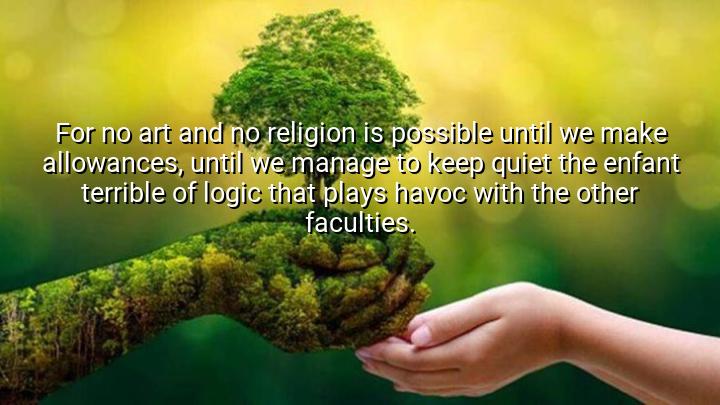




John Crowe Ransom’s quote, "For no art and no religion is possible until we make allowances, until we manage to keep quiet the enfant terrible of logic that plays havoc with the other faculties," reflects on the tension between reason and the more intuitive, creative aspects of human experience. Ransom suggests that both art and religion require a suspension of the strict, often restrictive rules of logic. The term "enfant terrible" refers to a disruptive force, in this case, the logic that often stifles the more spontaneous, emotional, and imaginative faculties that are essential to both creative expression and spiritual experience.
Ransom is implying that both art and religion thrive when they are freed from the constant scrutiny of rational thought. Art, whether visual, musical, or literary, often requires an openness to the unknown, a willingness to explore feelings and experiences that cannot be fully understood or explained through logic. Similarly, religion involves faith and spiritual understanding that transcend the limitations of reason, relying on belief, mystery, and transcendence. Ransom calls for a balance where the rational mind allows space for these other faculties to flourish.
The idea behind the quote emphasizes the necessity of emotional and intuitive engagement when it comes to understanding both art and religion. If we focus too heavily on logic and analysis, we risk reducing art to mere technique and religion to dogma, losing the deeper, transcendent qualities that make them so powerful. Ransom suggests that we need to make allowances for the irrational, the mysterious, and the ineffable, which are often where the true essence of art and religion can be found.
The origin of this quote is tied to Ransom’s broader views on literature, art, and the role of the intellect. As a prominent Southern poet, critic, and leader of the Fugitive poets, Ransom often explored the tension between reason and imagination, as well as the importance of mystery in both creative and spiritual pursuits. His reflections on the relationship between logic and the other faculties highlight the necessity of embracing the irrational to truly engage with the profound dimensions of human existence.

AAdministratorAdministrator
Welcome, honored guests. Please leave a comment, we will respond soon