

For much of history it was possible to believe that the great diversity of life on Earth was a fixed creation, that the living world had never changed. But when the first stirrings of industry demanded that fuel be dug from the earth and hillsides be leveled for roads and railways, the Earth's true past was dug up in abundance.
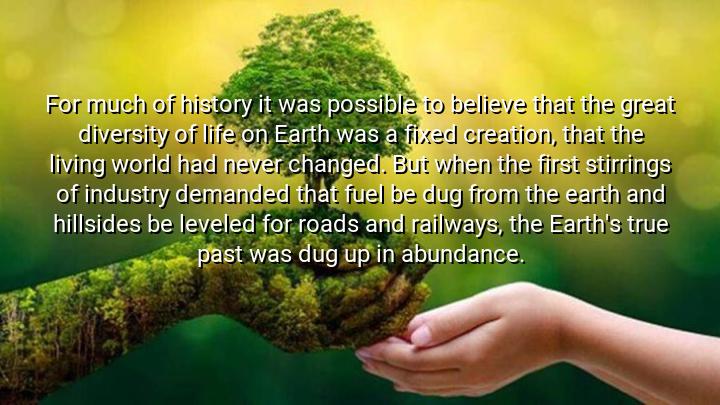




Kenneth R. Miller’s quote, "For much of history it was possible to believe that the great diversity of life on Earth was a fixed creation, that the living world had never changed," reflects the historical view that life on Earth was constant and unchanging. For centuries, many believed that the variety of life was part of a divine, fixed plan and that the Earth’s biological diversity had remained the same since creation. This idea of a static world fit with religious and cultural narratives that suggested no significant changes had taken place in nature’s design.
The second part of the quote, "But when the first stirrings of industry demanded that fuel be dug from the earth and hillsides be leveled for roads and railways, the Earth's true past was dug up in abundance," marks a pivotal shift in understanding. As industry grew, the need for resources such as fuel led to large-scale excavation and construction, unearthing fossils and geological formations that revealed evidence of dramatic changes in the Earth’s history. This process exposed the reality of evolution and the ever-changing nature of life, challenging earlier beliefs that the living world was immutable.
Originating from Miller’s background as a biologist and evolutionary theorist, the quote highlights the crucial role that industry and fossil discoveries played in uncovering the Earth’s deep history. The development of the fossil record, which revealed past life forms and their evolution over millions of years, helped shape our current understanding of evolution. These findings, prompted by industrial advancements, led to the acceptance of a dynamic and evolving Earth, where life forms have changed and adapted over time.
This quote underscores the intersection of science, history, and industry, showing how the advancement of technology and industry often leads to profound discoveries that reshape our understanding of the world. The act of digging into the Earth, once driven by the demands of industry, ultimately unearthed the true past of the planet, revealing the ongoing process of change and adaptation in nature.

AAdministratorAdministrator
Welcome, honored guests. Please leave a comment, we will respond soon