

For memory, we use our imagination. We take a few strands of real time and carry them with us, then like an oyster we create a pearl around them.
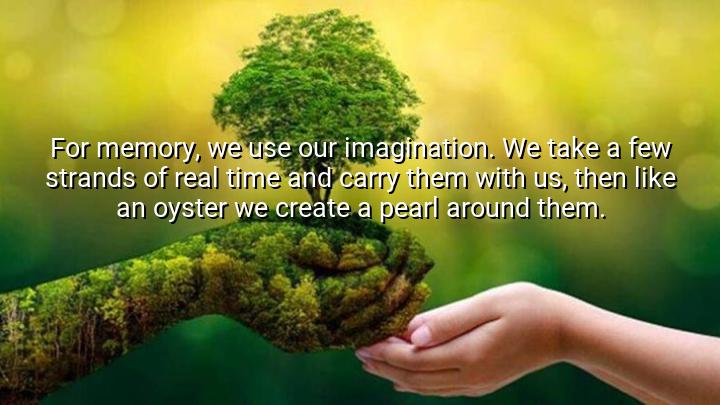




In the quote "For memory, we use our imagination. We take a few strands of real time and carry them with us, then like an oyster we create a pearl around them," John Banville reflects on the way memory functions as a blend of reality and imagination. He suggests that our memories are not static, objective recollections of the past, but are instead shaped by our creative minds. We take fragments of real experiences, "a few strands of real time," and, through the process of imagination, we transform them into something new, much like an oyster creating a pearl around a grain of sand.
Banville, an Irish novelist and short story writer known for his philosophical approach to fiction, often explores the themes of memory, identity, and the subjective nature of truth. This quote captures his view of memory as a constructive and dynamic process, rather than a simple recording of events. By likening memory to the creation of a pearl, he emphasizes how we embellish, reinterpret, or layer our memories over time, turning them into more refined and meaningful versions of the original events.
The metaphor of the oyster and pearl suggests that, just as an oyster builds up a beautiful, smooth surface around an irritating piece of grit, our minds add layers of emotion, meaning, and imagination around the raw material of our memories. This process not only preserves the past but also enhances it, creating something unique and deeply personal. In this way, memory becomes both a reflection of reality and a product of our own creativity and perception.
Ultimately, Banville’s quote highlights the complex, fluid nature of memory and how it is influenced by our own inner world. It suggests that memory is not simply a passive storage of past events, but an active process of reconstruction in which imagination plays a vital role. Through this lens, memories are not fixed truths, but living, evolving narratives that we carry with us, enriched and transformed by our own thoughts and experiences.

AAdministratorAdministrator
Welcome, honored guests. Please leave a comment, we will respond soon