

For me, architecture is the means, not the end. It's a means of making different life forms possible.
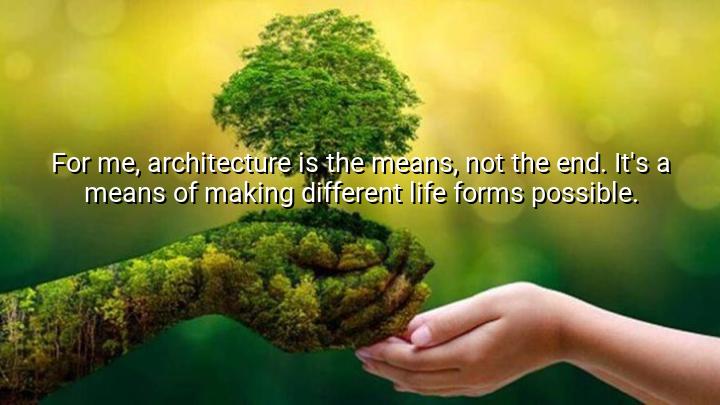




The quote "For me, architecture is the means, not the end. It's a means of making different life forms possible." by Bjarke Ingels encapsulates his belief that architecture is not about creating buildings for their own sake, but about enabling new ways of living. Ingels, a Danish architect and founder of the innovative firm BIG (Bjarke Ingels Group), sees architecture as a tool for transformation—a way to shape environments that support diverse, adaptable, and forward-thinking lifestyles. His approach focuses on function, flexibility, and social engagement, rather than purely aesthetic or theoretical goals.
By saying that architecture is a "means, not the end," Ingels challenges the traditional view of architecture as a final product or static object. Instead, he positions it as part of an ongoing process, one that responds to changing needs, climates, and cultures. This aligns with his practice, where projects often integrate sustainability, innovation, and playful design to reimagine how people interact with space—whether it's a housing complex shaped like a mountain or a power plant with a ski slope on its roof.
The phrase "making different life forms possible" speaks to architecture’s power to expand human potential. It implies that through thoughtful design, architecture can influence how communities function, how individuals connect, and how society evolves. In this sense, buildings are not just shelters, but platforms for new behaviors, experiences, and relationships. Ingels views his work as contributing to the creation of more inclusive, resilient, and imaginative futures.
This quote comes from Ingels’s lectures and writings where he articulates his philosophy of pragmatic utopianism—the idea that architecture should merge idealism with realism to create tangible improvements in everyday life. His vision positions the architect not as a mere form-maker, but as a facilitator of possibility, using the built environment to provoke positive change in how we live and interact with the world around us.

AAdministratorAdministrator
Welcome, honored guests. Please leave a comment, we will respond soon