

For many young women, the dream of independence and a home of their own is a tantalising goal, while a lifetime devoted solely to catering for another person's needs would be hard to countenance.
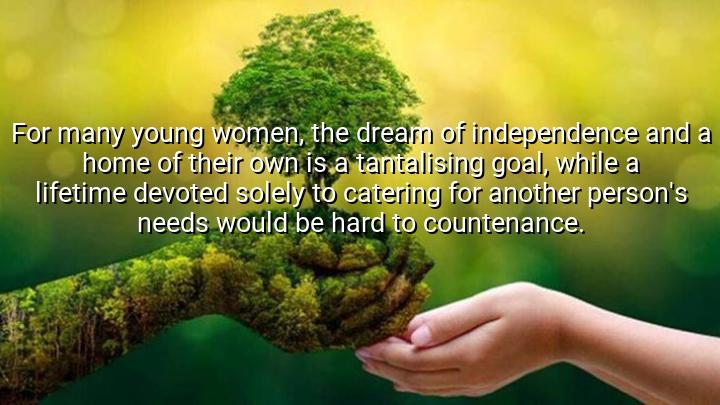




Mariella Frostrup’s quote reflects the evolving aspirations of young women in contemporary society. She suggests that the dream of independence—having a home of their own—is an attractive and empowering goal for many women. This goal symbolizes freedom, self-sufficiency, and the ability to make independent decisions, highlighting the shift in how women envision their futures. It reflects the growing desire for autonomy and the importance of personal space in achieving a fulfilling life.
The second part of the quote addresses the notion of self-sacrifice. Frostrup points out that a life dedicated solely to catering for another person’s needs—whether as a wife, mother, or caregiver—may be unappealing to modern women. The phrase "hard to countenance" implies that the idea of sacrificing one’s own goals and ambitions for the sake of others’ needs is increasingly seen as a difficult or undesirable prospect. This highlights a significant shift in attitudes towards gender roles and personal fulfillment.
Frostrup’s statement is rooted in the broader societal changes that have occurred in recent decades, where women have gained more independence and opportunities for self-actualization outside traditional domestic roles. The growing availability of career options, education, and the emphasis on self-empowerment have reshaped how women approach their lives and relationships. The idea of creating a home for oneself, rather than for someone else, signifies a move toward self-ownership and personal agency.
In essence, Frostrup’s quote captures the tension between traditional expectations of women’s roles and the modern desire for personal independence. It speaks to the broader cultural shifts that allow women to pursue their own dreams and ambitions, challenging old norms that once confined women to domestic spheres. The quote suggests that women today are more inclined to seek lives where they can balance independence with meaningful relationships, rather than dedicating themselves entirely to the needs of others.

AAdministratorAdministrator
Welcome, honored guests. Please leave a comment, we will respond soon