

For imagination sets the goal picture which our automatic mechanism works on. We act, or fail to act, not because of will, as is so commonly believed, but because of imagination.
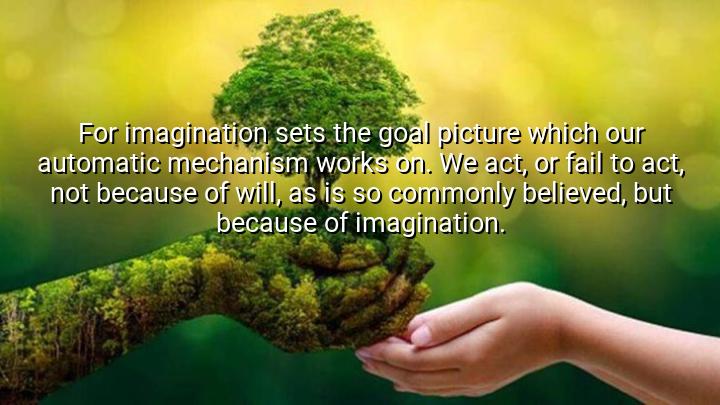




The quote "For imagination sets the goal picture which our automatic mechanism works on. We act, or fail to act, not because of will, as is so commonly believed, but because of imagination" by Maxwell Maltz suggests that our actions are guided not by sheer willpower but by the mental images created by our imagination. Maltz emphasizes that the images we hold in our minds—our envisioned goals, desires, and beliefs—serve as the blueprint for our behavior. Whether we succeed or fail in achieving something is less about force of will and more about the strength and clarity of the imagination that drives our actions.
The origin of this quote comes from Maltz's work in psychology and self-improvement. As a plastic surgeon and author of Psycho-Cybernetics, Maltz developed the concept of self-image and its role in personal achievement. He believed that the mind functions like a goal-seeking mechanism, responding to the images we create in our subconscious, which then influence our behavior. According to Maltz, imagination plays a crucial role in shaping these mental images, making it a central force in determining our actions and outcomes.
Maltz’s statement challenges the common belief that will alone drives action. He argues that imagination is the true guiding force, providing the mental direction and purpose that our subconscious mind follows. If we see ourselves succeeding in our goals, our automatic mechanism (which can be understood as our subconscious or habitual behavior patterns) works to make those images a reality. Conversely, if our imagination is filled with doubt or failure, that too can become our self-fulfilling prophecy, guiding us toward inaction or defeat.
In essence, Maltz’s quote underscores the power of imagination in shaping our lives. It suggests that the goal picture created by the imagination is a powerful force in guiding our behavior, more so than conscious will. By changing the images we hold in our minds—visualizing success and possibility—we can influence our actions and outcomes, unlocking the potential for personal growth and achievement.

AAdministratorAdministrator
Welcome, honored guests. Please leave a comment, we will respond soon