

For death is no more than a turning of us over from time to eternity.
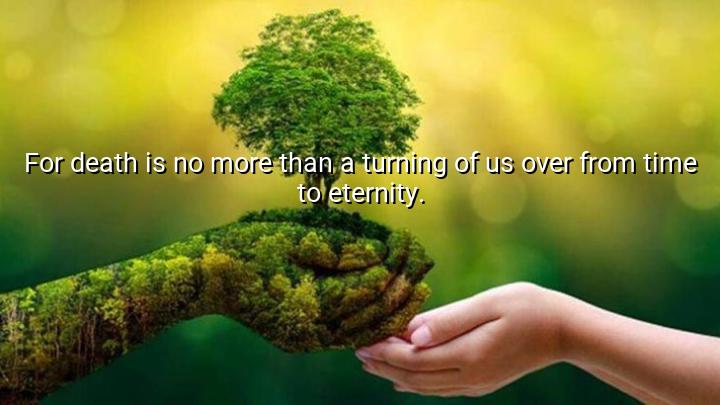




In this quote, William Penn, the English Quaker and founder of the Pennsylvania colony, presents a spiritual and philosophical view of death. He suggests that death is not an end but rather a transition from the confines of time into the infinite realm of eternity. By describing death as a "turning of us over," Penn implies that it is a movement or shift, not a definitive cessation of existence.
Penn’s perspective reflects his Quaker beliefs, which emphasized a deep connection to the spiritual realm and the idea of eternal life. In this view, death is seen not as something to fear, but as a natural progression towards a higher state of being. The concept of eternity signifies an existence beyond the physical world, where time and its limitations no longer apply.
The quote also challenges the commonly held fear of death by reimagining it as a part of a continuous journey. Instead of seeing it as the final end, Penn frames death as a spiritual passage, offering comfort to those who may fear the unknown. The idea of eternity provides a sense of peace, suggesting that life continues in some form beyond the physical world.
Ultimately, Penn’s words encourage a shift in how we perceive death, urging us to see it as a natural and transformative part of existence. His interpretation invites us to view life and death as interconnected steps in a larger, spiritual journey, with death being merely a transition into the infinite unknown of eternity.

AAdministratorAdministrator
Welcome, honored guests. Please leave a comment, we will respond soon