

Fling but a stone, the giant dies.
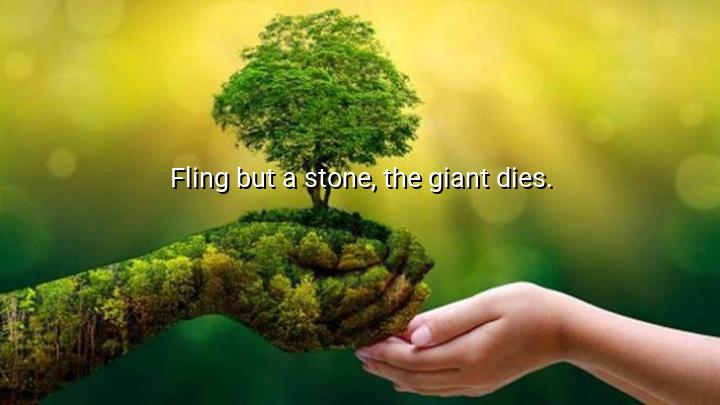




The quote "Fling but a stone, the giant dies" by Matthew Green highlights the idea that even the most powerful or seemingly invincible figures can be brought down by a single, small action or weakness. The metaphor of a giant represents something or someone powerful, while the simple act of flinging a stone symbolizes a small, seemingly insignificant action that can have a profound impact. Green suggests that vulnerability exists even in the strongest entities, and sometimes, it only takes a slight challenge or attack to bring them to their downfall.
The origin of this quote lies in Green’s work, likely in his satirical or philosophical writings, where he often used wit and metaphor to comment on human nature, society, and power. As an English poet and satirist, Green frequently explored themes of fragility and impermanence, particularly the idea that nothing is truly invincible. This quote is a reminder that even those who seem unassailable can be taken down by seemingly minor events or actions, exposing the precariousness of power.
The metaphor of the giant also suggests that arrogance or hubris can be a major flaw in powerful individuals or institutions. By positioning the giant as something that appears indestructible, Green underscores the irony that such entities are often vulnerable to the very things they may dismiss as inconsequential. The stone, a small object, can represent the humility or resilience that challenges the established order.
In essence, this quote serves as a reflection on the fragility of power and the potential of even the most minor efforts to disrupt or overthrow something that seems invulnerable. Green’s words encourage recognition of the hidden vulnerabilities within even the most seemingly unassailable structures, reminding us of the power in small, targeted actions.

AAdministratorAdministrator
Welcome, honored guests. Please leave a comment, we will respond soon