

Finality is death. Perfection is finality. Nothing is perfect. There are lumps in it.
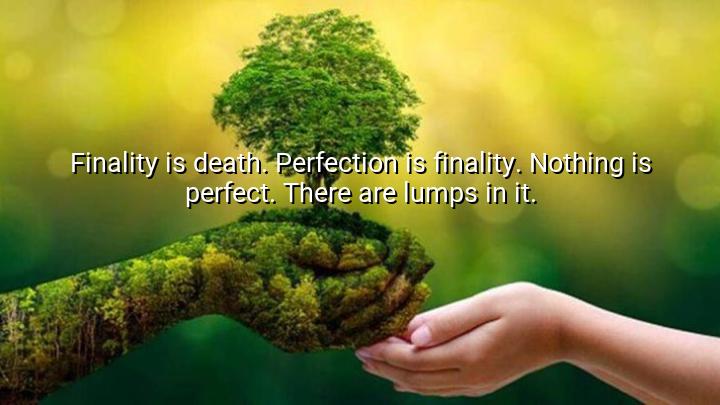




The quote "Finality is death. Perfection is finality. Nothing is perfect. There are lumps in it." by James Stephens, an Irish poet and novelist, explores the relationship between finality and imperfection. Stephens suggests that finality, or the idea of something being completed or set without the possibility of change, is akin to death—the ultimate form of finality. In this view, perfection represents a state where nothing more can be added or improved upon, which he equates with an end, as perfection would imply the absence of growth, change, or possibility.
Stephens goes on to argue that nothing is truly perfect, as all things inherently have flaws or imperfections, which he describes as "lumps." These "lumps" symbolize the natural imperfections that exist in life, art, and people. Rather than striving for an unattainable ideal of perfection, Stephens suggests that imperfection is a natural part of existence and should be embraced as part of the beauty and complexity of life. The idea that "nothing is perfect" serves as a reminder that imperfection is not only inevitable but also valuable in making things unique and real.
The origin of this quote comes from Stephens' literary works, where he often grappled with themes of human nature, creativity, and existential reality. As a writer, Stephens was concerned with the tensions between ideals and the practical world, exploring how people navigate the imperfections of life. His works are often marked by a poetic approach to these philosophical reflections, using metaphors and simple language to address complex ideas like perfection and finality.
Ultimately, this quote challenges the pursuit of unattainable perfection and instead encourages the acceptance of imperfection as an essential part of life. By linking finality with death, Stephens reminds us that the search for perfection can limit growth and creativity, whereas embracing the lumps—the flaws and imperfections—can lead to a more fulfilling and authentic experience. This perspective invites us to find beauty in the incomplete and imperfect rather than striving for an unattainable ideal.

AAdministratorAdministrator
Welcome, honored guests. Please leave a comment, we will respond soon