

Everybody's business is nobody's business, and nobody's business is my business.
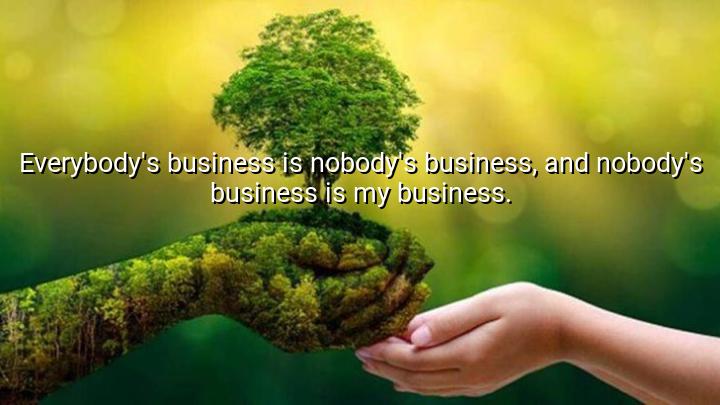




The quote "Everybody's business is nobody's business, and nobody's business is my business." by Clara Barton reflects a powerful sense of personal responsibility and initiative. In this statement, Barton is expressing her belief that when a problem is considered everyone’s responsibility, it often ends up being ignored, because people assume someone else will take care of it. The first part—"Everybody's business is nobody's business"—highlights this phenomenon of collective inaction.
The second part of the quote—"nobody's business is my business"—reveals Barton's deep commitment to stepping in where others may hesitate. Rather than turning away from difficult or neglected problems, she chose to own them. This mindset aligns closely with her life’s work as the founder of the American Red Cross, where she took action in places of extreme need—battlefields, disaster zones, and communities that others had forgotten or avoided. For Barton, compassion and duty meant taking on the causes that didn’t clearly "belong" to anyone else.
This quote likely emerged from her experiences during the Civil War and her humanitarian efforts afterward, where she witnessed firsthand how bureaucracy or apathy could leave urgent needs unmet. In those moments, she didn’t wait for instruction or consensus—she simply acted. Her words serve as a critique of passivity and a call to personal leadership, particularly in situations where lives or dignity are at stake.
Ultimately, Clara Barton's quote champions the value of individual action in the face of collective neglect. It reminds us that waiting for others to step up often results in nothing being done—and that true progress depends on those who are willing to take on "nobody’s business" as their own. Her legacy stands as a testament to what one person can achieve by claiming that responsibility.

AAdministratorAdministrator
Welcome, honored guests. Please leave a comment, we will respond soon