

Every religion implies that it treats the problem of being and nonbeing, life and death. Their languages are different, but they speak about the same things.
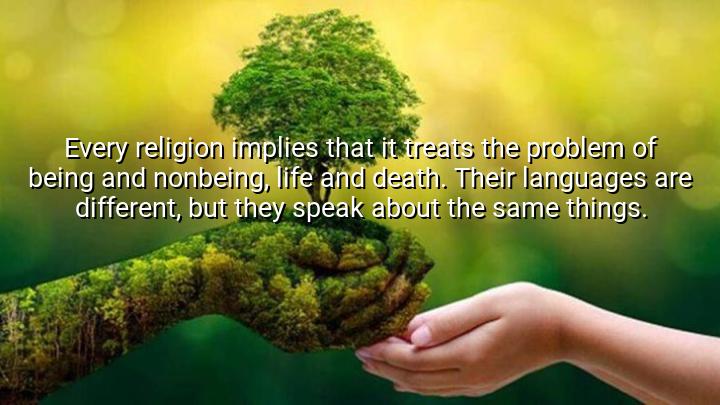




The quote by Mircea Eliade, a renowned historian of religion and philosopher, highlights the common theme shared by all religions: the exploration of being and nonbeing, as well as life and death. Eliade suggests that while the languages and symbols used by different religious traditions may vary, they all seek to address the same fundamental human concerns—the nature of existence, the transition from life to death, and the mysteries of what happens beyond death. These themes are central to human experience, making them universal across cultures and belief systems.
Eliade’s statement reflects his broader academic perspective on religion, which emphasizes the deep, transcendent questions that all religions attempt to answer. Regardless of cultural differences, each religion provides a framework for understanding the mysteries of life and death, offering spiritual answers to existential questions. The rituals, myths, and beliefs of different religious traditions may differ, but they ultimately point to a common human desire to make sense of the unknown and find meaning in life and death.
The origin of this quote comes from Eliade’s extensive work on the comparative study of religions. In his writings, particularly in The Sacred and the Profane, Eliade explored how religious symbols and practices help humans navigate the profound realities of existence. By recognizing the universal themes of being and nonbeing, Eliade sought to demonstrate how religions, despite their apparent differences, share a fundamental concern with the mysteries of life and mortality.
In essence, Eliade’s quote reminds us that while religions may express their teachings in diverse ways, they all grapple with the same core human questions: What is life? What happens after death? What is the nature of existence? By acknowledging the shared concerns across religions, Eliade emphasizes the commonality of the human experience, transcending cultural and doctrinal boundaries.

AAdministratorAdministrator
Welcome, honored guests. Please leave a comment, we will respond soon