

Every man, either to his terror or consolation, has some sense of religion.
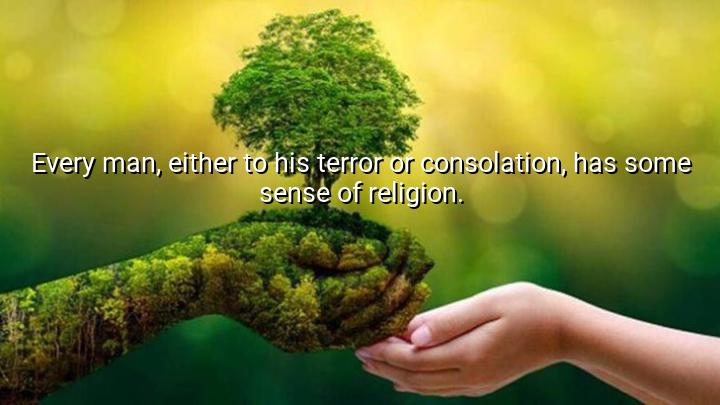




The quote "Every man, either to his terror or consolation, has some sense of religion" by Heinrich Heine suggests that religion plays a fundamental, inescapable role in human life, whether through fear or comfort. Heine, a German poet and philosopher, recognized that religion profoundly shapes the way individuals perceive their existence, morality, and ultimate purpose. For some, it brings comfort, offering hope, solace, and a sense of belonging. For others, it might invoke terror, whether due to fear of divine judgment or the weight of existential questions about life, death, and the afterlife.
The phrase implies that religion is not merely an abstract concept or a societal construct but a deep-seated element of human nature that affects individuals on a personal level. Even those who reject traditional faiths or question their beliefs are still, in a sense, influenced by religion. It could be in the form of skepticism, doubt, or a search for meaning in a world that seems chaotic and uncertain.
Heine, a critic of both political and religious institutions, often expressed disillusionment with the dogma of his time. However, his statement here captures the complexity of human engagement with the divine or the sacred. While some may find peace or a moral compass in religion, others are haunted by its moral imperatives, its power structures, or its implications on personal freedom. In either case, a sense of religion remains integral to the human condition.
The quote reflects Heine's belief in the universality of religion's influence, not necessarily in the traditional sense of worship, but as a profound aspect of human consciousness that shapes emotional and intellectual life, whether positively or negatively. It invites reflection on the role of belief in navigating the complexities of existence.

AAdministratorAdministrator
Welcome, honored guests. Please leave a comment, we will respond soon