

Every human being, of whatever origin, of whatever station, deserves respect. We must each respect others even as we respect ourselves.
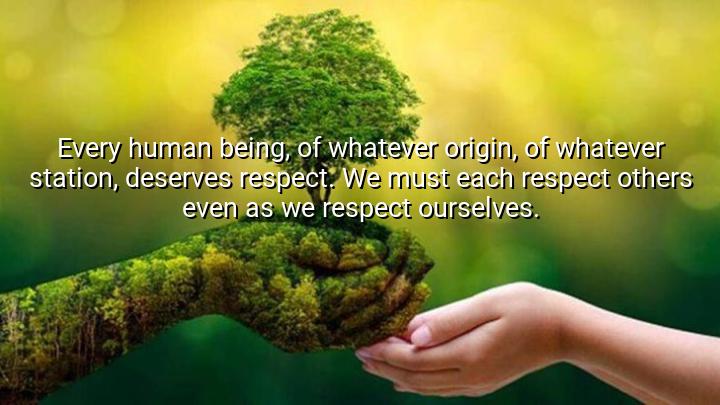




The quote, “Every human being, of whatever origin, of whatever station, deserves respect. We must each respect others even as we respect ourselves.”, by U Thant, conveys a universal message of human dignity and equality. It stresses that no matter a person’s origin—their race, culture, or nationality—or their station in life—whether rich, poor, powerful, or powerless—they are entitled to respect. U Thant links this to the idea of mutual respect, pointing out that honoring others is inseparable from honoring oneself.
The origin of this statement lies in U Thant’s role as Secretary-General of the United Nations from 1961 to 1971. During his tenure, the world was navigating some of the most difficult moments of the Cold War, including the Cuban Missile Crisis, the Vietnam War, and the struggles of newly independent nations. His words reflect the UN’s core mission of promoting peace, cooperation, and human rights across all divides. As a Burmese diplomat deeply influenced by Buddhist philosophy, U Thant often emphasized compassion, tolerance, and the interconnectedness of humanity.
The deeper meaning of this quote can be seen as a reminder that respect is the foundation of peaceful coexistence. Without it, divisions based on race, class, or ideology only breed conflict. By urging people to extend the same respect to others that they demand for themselves, U Thant highlights the principle of reciprocity at the heart of both ethics and diplomacy. It’s a call to dismantle prejudice and to embrace a shared sense of humanity.
Ultimately, the quote is both moral and practical: societies cannot function in harmony if respect is unevenly applied. U Thant’s vision was not abstract—it was a guiding principle for international relations, reconciliation, and everyday interactions between people. His words remain relevant today in a world still struggling with inequality, discrimination, and cultural divides.
Would you like me to also connect this quote to the Universal Declaration of Human Rights, which reflects a very similar spirit?

AAdministratorAdministrator
Welcome, honored guests. Please leave a comment, we will respond soon