

Even knowledge has to be in the fashion, and where it is not, it is wise to affect ignorance.
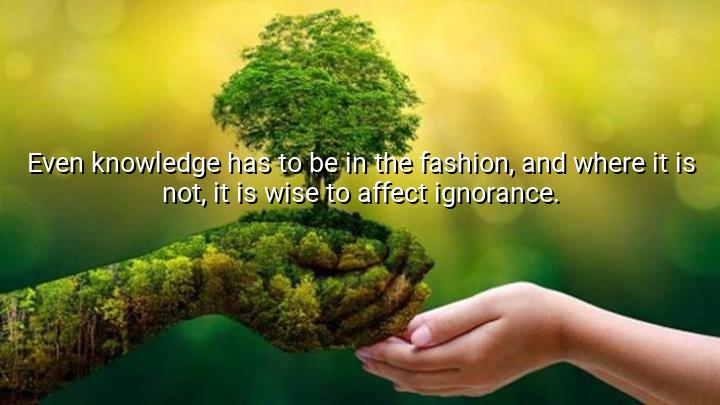




The quote "Even knowledge has to be in the fashion, and where it is not, it is wise to affect ignorance." by Baltasar Gracián highlights the relationship between knowledge, society, and perception. Gracián suggests that what people value as knowledge often depends on whether it aligns with the trends, beliefs, and customs of the time. In situations where knowledge goes against the prevailing fashion, openly displaying it may be dangerous or unwise. Thus, pretending ignorance can sometimes be a form of wisdom.
The meaning of this quote lies in its cautionary advice about social intelligence. Gracián acknowledges that truth and knowledge do not always guarantee acceptance or respect. At times, showing that you know something unpopular or out of sync with the current cultural climate may lead to criticism, hostility, or alienation. Therefore, a wise person discerns not only what is true, but also when and how to reveal it. This reflects the art of practical wisdom—balancing honesty with discretion.
The origin of the quote comes from Gracián’s famous work “The Art of Worldly Wisdom” (1647), a collection of aphorisms offering guidance on how to navigate human interactions, politics, and power dynamics. As a Spanish Jesuit philosopher during the Baroque period, Gracián often wrote about the tension between authenticity and survival in social life. His insights reflected the complex political and religious environment of 17th-century Spain, where expressing the wrong knowledge could have serious consequences.
Ultimately, Gracián’s statement serves as both a warning and a strategy. It reminds us that wisdom is not only about acquiring knowledge but also about knowing when to use it—or conceal it. In this sense, the quote reveals a timeless truth: sometimes, silence and restraint can be more powerful than openly displaying one’s knowledge.

AAdministratorAdministrator
Welcome, honored guests. Please leave a comment, we will respond soon