

Engineering, medicine, business, architecture and painting are concerned not with the necessary but with the contingent - not with how things are but with how they might be - in short, with design.
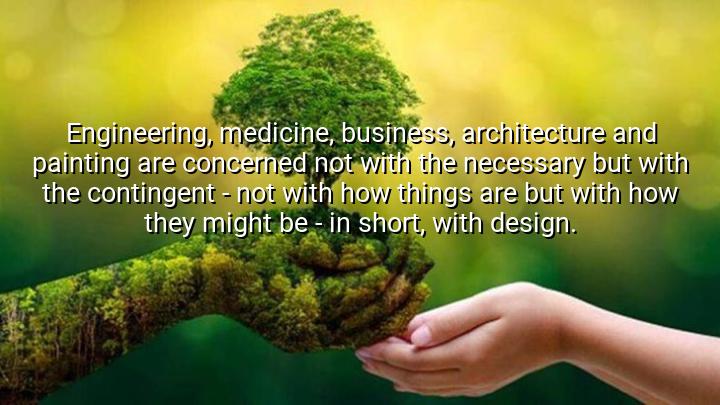




The quote by Herbert A. Simon, "Engineering, medicine, business, architecture and painting are concerned not with the necessary but with the contingent... in short, with design," offers a profound insight into the nature of design thinking across disciplines. Simon, a Nobel Prize-winning economist, cognitive scientist, and pioneer in artificial intelligence, argues that fields like engineering, medicine, business, architecture, and art are not about describing how the world is, but about imagining how it could be. They deal with the contingent—the possible, the variable, the changeable.
By drawing attention to the contrast between the necessary (what must be) and the contingent (what could be), Simon highlights the role of human agency, creativity, and decision-making in shaping outcomes. These disciplines are united by a common process: design. Whether it's a building, a business model, a medical treatment, or a painting, each is a response to a set of problems and possibilities, guided not by fixed laws, but by choices, goals, and contextual understanding.
In his influential book The Sciences of the Artificial (1969), Simon developed this idea further, positioning design as the core methodology behind all human-made systems. He viewed design not as limited to the arts, but as the defining intellectual activity of professionals who shape the world through plans, models, and systems. His work laid the foundation for modern design thinking, which is now widely used in innovation, education, and problem-solving.
Ultimately, Simon’s quote redefines design as a universal process that transcends specific fields. It invites us to see doctors, engineers, and business leaders not just as problem-solvers, but as designers of futures. His message is empowering: the world isn’t fixed—it’s something we can reshape, and through design, we continually reimagine what life can be.

NVNgoc Van
Simon’s quote really changes how I think about the boundaries between science, art, and practice. It makes me wonder—if all these disciplines are forms of design, then is creativity the most important skill across industries? Should we be teaching creative problem-solving as a core competency in all professions? I’d love to hear how current educational systems are embracing or resisting this idea. It feels both radical and incredibly logical.
GDGold D.dragon
This quote surprised me. I usually think of fields like architecture and painting as expressive, but I hadn't considered medicine or business in the same light. Does this mean doctors and CEOs are designers, too? If so, is the design process just as vital to saving lives or running companies as it is to creating buildings or artworks? I’m curious how professionals in those fields interpret their roles through this lens.
TKdang vo tien khoa
I find this perspective really uplifting. It unites such different disciplines under a shared purpose: shaping what could be. But I also wonder—does this blur the line between objective analysis and subjective intention? In a business context, for example, how do we balance imaginative design with data-driven decision-making? Is Simon suggesting that innovation is a design act in itself, regardless of the industry it occurs in?
MK7TA9.14 Le Minh Khoi
As a reader, this quote makes me reflect on the power of possibility. It suggests that all these fields are not just reactive but visionary. But then I wonder—does this view downplay the importance of empirical evidence and rigor, especially in fields like medicine or engineering? How do we reconcile the idea of 'how things might be' with the responsibility to ensure safety, accuracy, and real-world effectiveness?
LTPham thi le thuong
This quote fascinates me because it reframes disciplines we often consider purely technical—like engineering or medicine—as fundamentally creative. Is Simon saying that at their core, these fields are more about imagination than hard facts? If so, what does that mean for how we educate future professionals? Should design thinking be central to all curricula, even in traditionally 'scientific' fields? I’d love to explore how this mindset changes real-world problem-solving.