

Death, so called, is a thing which makes men weep, And yet a third of life is passed in sleep.
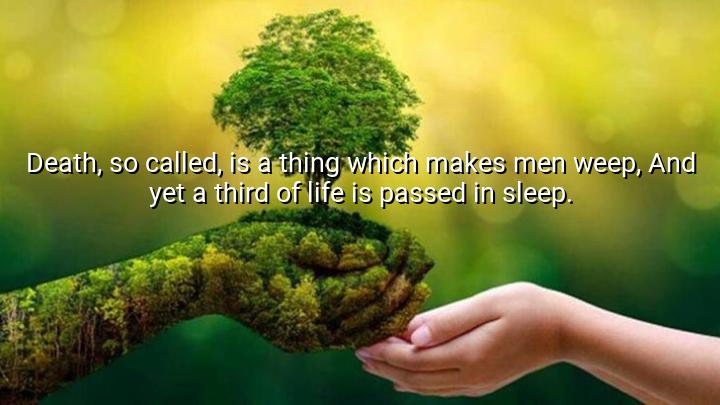




The quote "Death, so called, is a thing which makes men weep, And yet a third of life is passed in sleep." by Lord Byron presents a reflection on the inevitability and nature of death. Byron, a prominent poet of the Romantic era, often explored deep philosophical and existential themes in his work. In this quote, he draws a parallel between death and sleep, both of which are often perceived as states of unconsciousness or transition. Byron points out the paradox that while death is often feared and mourned, sleep—which is similar to death in the sense that it removes us from the waking world—is a routine part of life, experienced without the same level of fear or mourning.
Byron’s comparison between death and sleep suggests that both are natural and inevitable parts of the human experience. He notes that while death is traditionally feared and grieved, it shares certain qualities with sleep, an everyday occurrence. His observation that a third of life is spent in sleep implies that the boundaries between life and death are not as clear-cut as they are often portrayed. The phrase encourages us to reconsider our perception of death, perhaps suggesting that it is not as foreign or terrifying as society tends to make it.
The quote also speaks to the transient nature of life and the cyclical rhythms of existence. In Byron’s view, both sleep and death are essential parts of life’s natural cycle, representing states of rest, renewal, and change. By linking sleep with death, he may be inviting readers to view both with a sense of acceptance and recognition that they are integral to the flow of life.
Ultimately, Byron’s quote invites reflection on the relationship between life and death, encouraging us to rethink our fear of death by recognizing the parallels between it and the more familiar experience of sleep. It suggests that perhaps death, like sleep, is a necessary and inevitable part of the human experience, one that should be approached with a sense of acceptance rather than fear.

AAdministratorAdministrator
Welcome, honored guests. Please leave a comment, we will respond soon