

Death is the separation of soul from body.
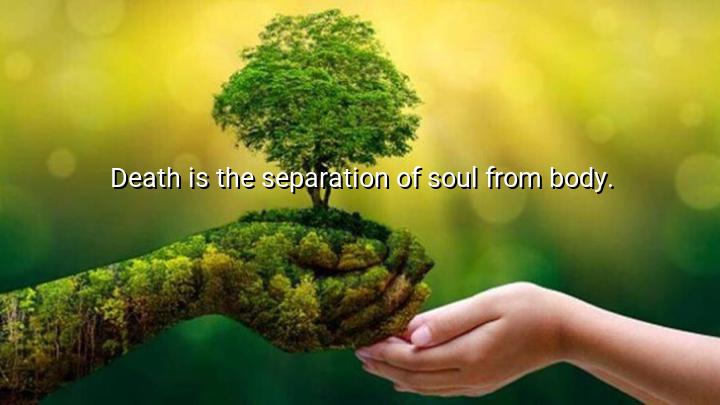




The quote "Death is the separation of soul from body" by Chrysippus, a Stoic philosopher, reflects a fundamental understanding of death in Stoic philosophy. For Chrysippus and many other Stoics, death was viewed as a natural and inevitable process that occurs when the soul—the life force or rational element—departs from the body. This separation marks the end of life, as the body without the soul is no longer considered capable of functioning. The quote encapsulates the Stoic view that death is not something to be feared but is simply a natural part of existence.
In Stoicism, death is not seen as an evil or something to be mourned excessively, as the Stoics believed in accepting the natural course of life. Chrysippus, in his explanation, presents death as a neutral event, emphasizing that it is simply a separation rather than something tragic or undesirable. The Stoic attitude toward death was rooted in the understanding that it was beyond human control, and thus, it was important to face it with equanimity and without undue emotional distress.
The origin of this quote comes from Chrysippus’ writings on Stoic philosophy, where he explored the nature of the soul, the body, and their relationship to the universe. Chrysippus was a key figure in developing Stoic thought, and his views on death were consistent with the broader Stoic belief in accepting life's inevitable events with rationality and composure. He saw the separation of soul and body not as an unnatural event but as a part of the natural cycle of life and the universe.
Ultimately, this quote highlights the Stoic view that death is an impersonal event, one that should not be feared or resisted. Instead, death should be understood as the final moment of the soul's separation from the body, and as such, it is simply another transition in the cycle of existence. Chrysippus' words encourage us to approach death with a sense of acceptance and serenity, recognizing it as an inevitable part of life.

AAdministratorAdministrator
Welcome, honored guests. Please leave a comment, we will respond soon