

Death is the last enemy: once we've got past that I think everything will be alright.
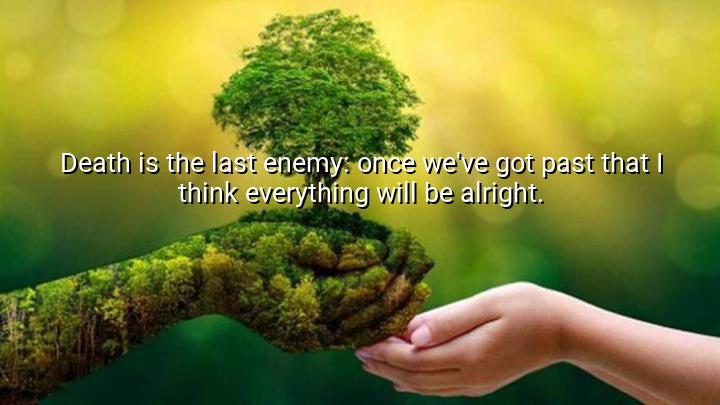




The quote "Death is the last enemy: once we've got past that I think everything will be alright" by Alice Thomas Ellis offers a reflection on death and its role as a final hurdle in life’s journey. Ellis, a British author known for her thoughtful and often introspective writing, suggests that death is the ultimate challenge humans face, but once it is overcome—whether through acceptance, spirituality, or the natural process of living—it no longer poses a threat. The quote expresses the idea that once death is conquered, whether literally or metaphorically, all other struggles become manageable.
The origin of this quote reflects Ellis's perspective on life’s inevitable mortality. For her, death represents the ultimate adversary in the human experience, the one challenge that cannot be avoided or evaded. However, she also suggests that this fear of death is something that can be transcended with time, understanding, or acceptance. By stating that "once we've got past that," she implies that death may not be as daunting when viewed as a natural, inevitable part of life.
Ellis’s viewpoint underscores the notion that death, though feared by many, is the one event we all must eventually face. Once acceptance of death is achieved, either through philosophical understanding or spiritual belief, it becomes less of an enemy and more a part of the cycle of life. The rest of life's difficulties, according to Ellis, seem less significant in comparison to this final challenge, offering the possibility of peace and reconciliation.
Ultimately, Ellis's quote encourages a perspective on life and death that is rooted in acceptance and perspective. It suggests that confronting and embracing mortality can bring a sense of relief and clarity, helping to put other challenges into perspective. Once the fear of death is addressed, it implies, everything else in life may feel more manageable and understandable.

AAdministratorAdministrator
Welcome, honored guests. Please leave a comment, we will respond soon