

Death is not the worst that can happen to men.
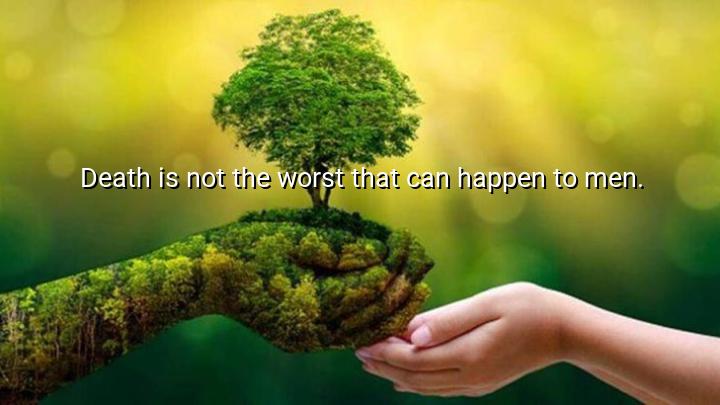




Plato’s quote, "Death is not the worst that can happen to men," challenges the conventional fear of death and invites deeper reflection on what constitutes true harm in life. Plato suggests that while death is often feared, it may not be the most tragic event one can experience. Instead, the quote implies that the greatest misfortune is living a life that lacks meaning, integrity, or virtue. For Plato, living poorly or failing to fulfill one’s purpose is worse than physical death because it reflects a failure to live in accordance with righteousness or to achieve true happiness.
This idea is rooted in Plato's belief in the importance of the soul and the pursuit of virtue. In his philosophical works, particularly in the Apology, Plato often emphasized that the health of the soul is far more important than the health of the body. If a person lives a life that is morally corrupt or spiritually empty, they are subjected to a form of spiritual death that can be more devastating than the physical end of life itself. In this context, Plato teaches that the virtue and integrity of one’s life should be the true measure of success.
Plato’s philosophy centers around the idea of achieving the good life, which involves the pursuit of wisdom, knowledge, and ethical behavior. In his view, death is a natural part of existence and should not be feared if one has lived a life of virtue. The worst fate is a life lived without pursuing truth, wisdom, and justice, as these are the elements that give life meaning, regardless of its length.
The origin of this quote comes from Plato’s broader philosophical teachings on ethics, morality, and the nature of the soul. His discussions in dialogues such as the Republic and Phaedo revolve around the pursuit of the good and the recognition that death is not the ultimate evil but rather the failure to live a life rooted in wisdom and virtue. Plato’s view on death challenges us to reflect on how we live and the moral choices we make, urging us to focus on the life of the soul rather than the inevitable end of the body.

AAdministratorAdministrator
Welcome, honored guests. Please leave a comment, we will respond soon