

Death is not more certainly a separation of our souls from our bodies than the Christian life is a separation of our souls from worldly tempers, vain indulgences, and unnecessary cares.
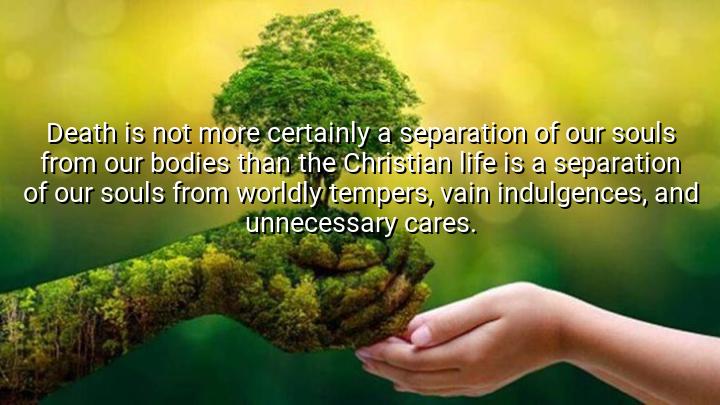




The quote "Death is not more certainly a separation of our souls from our bodies than the Christian life is a separation of our souls from worldly tempers, vain indulgences, and unnecessary cares" by William Law draws a comparison between death and the Christian life in terms of separation. Law, an 18th-century English theologian and mystic, suggests that just as death involves the physical separation of the soul from the body, the Christian life involves a metaphorical separation of the soul from worldly distractions, sinful desires, and materialism. This separation is seen as a spiritual cleansing or purification, essential to living a life that aligns with Christian teachings.
The origin of this quote lies in Law’s religious philosophy, which emphasized the importance of self-discipline, spiritual growth, and devotion to God. Law believed that true Christianity required more than just outward adherence to religious rituals—it demanded an inner transformation where one’s soul is freed from the distractions of the world, such as vanity, materialism, and the pursuit of pleasure. This separation from worldly concerns allows the soul to focus on spiritual and divine matters.
In this quote, Law highlights that just as death is an inevitable and defining moment in the human experience, so too is the Christian journey marked by a decisive shift away from worldly temptations. The comparison illustrates the depth and seriousness with which Law views the Christian life—it's not simply about following rules but about fundamentally changing one’s relationship to the world and its fleeting pleasures. This transformation, according to Law, is just as profound and inevitable as death itself.
Ultimately, this quote calls for reflection on how individuals prioritize their spiritual lives over their earthly desires. Law’s teaching encourages believers to live in a way that reflects sacrifice, self-control, and a constant focus on spiritual purity, turning away from the distractions and indulgences that hinder the soul’s connection to God. The separation he refers to is not just symbolic; it represents a radical shift toward a life of spiritual devotion.

AAdministratorAdministrator
Welcome, honored guests. Please leave a comment, we will respond soon