

Death is a word in the dictionary. I don't believe in that word. I think the most appropriate word is 'departure' because we are energy and you can't create or destroy energy, you can only change its form.
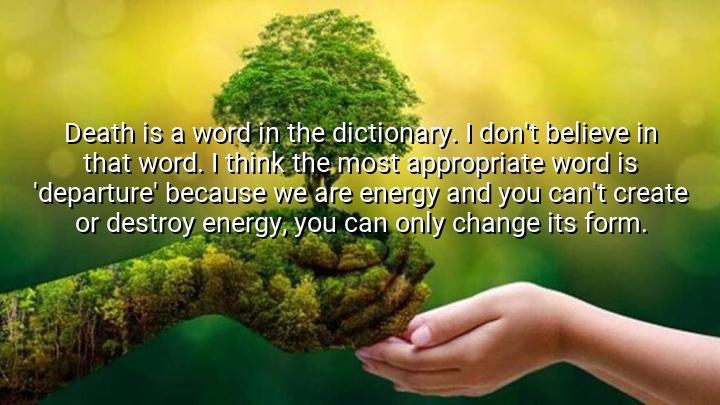




The quote "Death is a word in the dictionary. I don't believe in that word. I think the most appropriate word is 'departure' because we are energy and you can't create or destroy energy, you can only change its form." by Noel Edmonds challenges conventional ideas about death, presenting a more philosophical and spiritual perspective. Edmonds rejects the concept of death as an end and instead frames it as a departure—a transition, similar to how energy changes form rather than ceases to exist. His view suggests that life and death are part of an ongoing process where the energy of a person or soul continues in a different form, rather than disappearing entirely.
By equating death to energy's transformation, Edmonds is echoing the idea that nothing in the universe is truly destroyed; it only undergoes a change. This perspective aligns with scientific principles, such as the law of conservation of energy, which states that energy cannot be created or destroyed but only transformed from one state to another. Edmonds applies this to human existence, implying that the soul or energy of a person is eternal, merely shifting its form after the body ceases to function.
The word departure carries a more gentle, less final connotation than death, implying a continuation or journey beyond what we can physically see. For Edmonds, this shift in terminology reflects his spiritual belief in the permanence of energy. He suggests that death does not mark the end of existence, but rather a transition to another state of being, offering comfort and hope for those who fear the finality of death.
The origin of this quote lies in Edmonds' personal beliefs and his tendency to express unconventional views. As a British television presenter and entertainer, Edmonds often shared his thoughts on spirituality, life, and death publicly. This quote reflects his philosophical approach to life's most significant question, influenced by both spiritual ideas and scientific principles. By proposing a shift in language, Edmonds encourages others to think of death not as a loss but as a part of a larger cycle of transformation.

AAdministratorAdministrator
Welcome, honored guests. Please leave a comment, we will respond soon