

Death is a commingling of eternity with time; in the death of a good man, eternity is seen looking through time.
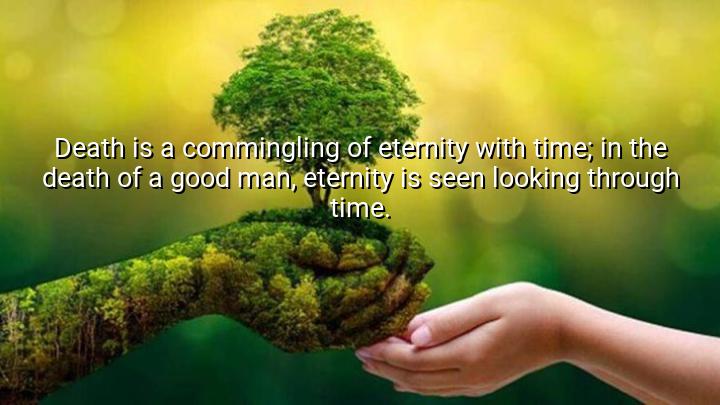




Johann Wolfgang von Goethe’s quote, "Death is a commingling of eternity with time; in the death of a good man, eternity is seen looking through time," reflects a philosophical and spiritual interpretation of the concept of death. Goethe suggests that death represents the meeting point between the finite world of time—the realm of living, changing experiences—and the infinite, eternal essence that transcends human existence. By describing death as a "commingling," Goethe emphasizes that death is not simply an end, but a transition where the timeless aspect of being intersects with the temporality of life.
In the second part of the quote, Goethe suggests that the death of a good man allows us to glimpse the eternal. A "good man" may symbolize someone who has lived a life of virtue, wisdom, and moral integrity, someone whose actions resonate beyond the confines of time. Through his death, the eternal qualities of humanity—such as love, truth, and goodness—are reflected in a temporal context, allowing us to see these enduring values in the finite world. Goethe’s words imply that the death of such individuals reminds us of a deeper, transcendent reality that exists beyond the physical world.
This view of death connects to Goethe’s broader philosophical reflections, particularly in his exploration of humanity and the mysteries of existence. For Goethe, death was not merely a tragic event but a profound moment that linked the temporal and the eternal, offering insight into the ongoing cycle of life and spirituality. It invites us to consider the ways in which life continues in its essence, even after the physical body ceases to exist.
The origin of this quote comes from Johann Wolfgang von Goethe, a German writer, poet, and philosopher renowned for his works such as Faust and The Sorrows of Young Werther. Goethe’s philosophy often merged elements of romanticism and spirituality, exploring the nature of human experience, death, and the connection between the material and spiritual realms. This quote reflects his belief that death, far from being an end, is an important moment that offers a glimpse into a deeper, eternal truth that transcends the physical world.

AAdministratorAdministrator
Welcome, honored guests. Please leave a comment, we will respond soon