

Death in itself is nothing; but we fear to be we know not what, we know not where.
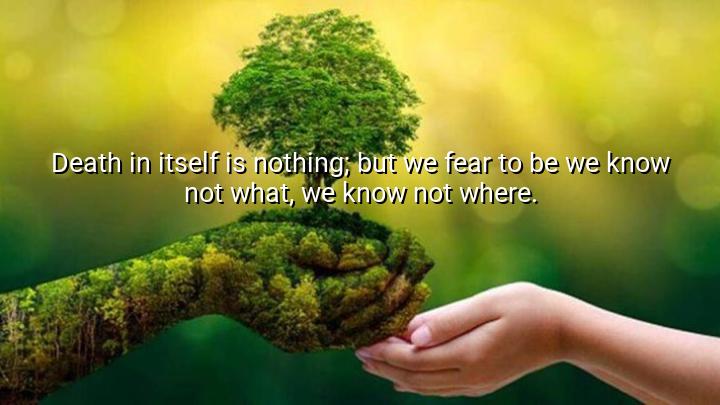




The quote by John Dryden, an English poet and playwright, explores the nature of death and the human fear surrounding it. Dryden suggests that death itself is not inherently terrifying—it is merely a natural event. However, what causes fear is the uncertainty of what comes after death, the unknown nature of it. People fear not knowing what they will become or where they will go once they pass away. This fear stems from the mystery of the afterlife, which remains beyond human comprehension.
Dryden's words point to the psychological aspect of fear, which is often more rooted in ignorance and uncertainty than in the event itself. Death, as a concept, is inevitable and can be seen as a transition, but the unknown afterlife is what makes it unsettling for many. The lack of understanding about what happens after death fuels a sense of dread and makes people reluctant to face it.
The origin of this quote comes from Dryden’s broader works, where he often delved into philosophical and existential themes, including mortality, fate, and human nature. His exploration of death is reflective of the human condition, where people are aware of the inevitable nature of death but struggle with the mysteries surrounding it. Dryden's literary works, such as The Flower and the Leaf and his many plays, often examined these complex emotions tied to human existence and the fear of the unknown.
In essence, Dryden’s quote highlights the power of fear that arises from the unknown, particularly regarding death. While the event itself may be neutral or inevitable, the fear comes from the human inability to comprehend what lies beyond. This existential uncertainty is what makes the idea of death so daunting, and Dryden captures this universal human fear that exists in the face of life's most profound mystery.

AAdministratorAdministrator
Welcome, honored guests. Please leave a comment, we will respond soon