

Death doesn't affect the living because it has not happened yet. Death doesn't concern the dead because they have ceased to exist.
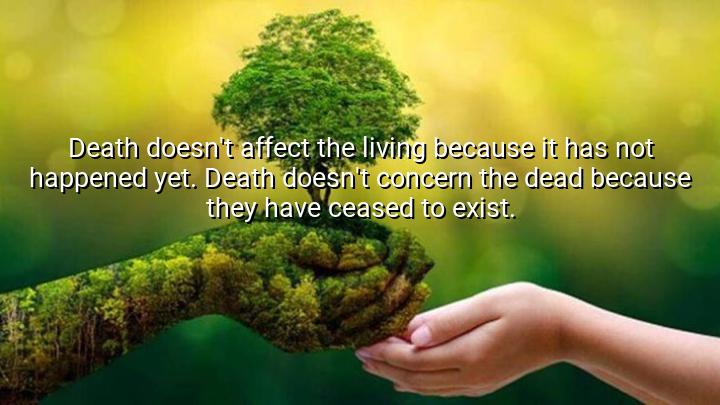




The quote "Death doesn't affect the living because it has not happened yet. Death doesn't concern the dead because they have ceased to exist" by W. Somerset Maugham offers a philosophical reflection on the nature of death and its impact on different entities. Maugham suggests that death is a concept that only affects those who are still alive and aware of it, but for the living, it is not a present concern until it becomes imminent. The idea that the living are untouched by death until it happens highlights how people often live in a state of denial or ignorance about their own mortality.
On the other hand, Maugham points out that death holds no relevance for those who have already passed away. For the dead, there is no consciousness or awareness, meaning that death has no effect on them as they have ceased to exist in any meaningful way. This suggests that death is a transition from existence to non-existence, and once a person is dead, they no longer experience the pain or fear of it.
The origin of this quote ties into Maugham’s literary exploration of themes like existentialism and the human condition. Known for his keen observations of society and his often ironic take on life's deeper questions, Maugham’s quote reflects a rational, almost detached understanding of death. It underscores his tendency to view complex emotions through a pragmatic lens, without overly romanticizing or fearing death.
Ultimately, Maugham’s words remind us of the dual nature of death: it is a reality for the living who must grapple with its inevitability, but it is a non-issue for the dead, who no longer exist to be affected by it. The quote invites reflection on how humans live in relation to their mortality, either by confronting or avoiding it, and how death is, for the dead, simply the end of all concerns.

AAdministratorAdministrator
Welcome, honored guests. Please leave a comment, we will respond soon