

Collaboration is important not just because it's a better way to learn. The spirit of collaboration is penetrating every institution and all of our lives. So learning to collaborate is part of equipping yourself for effectiveness, problem solving, innovation and life-long learning in an ever-changing networked economy.
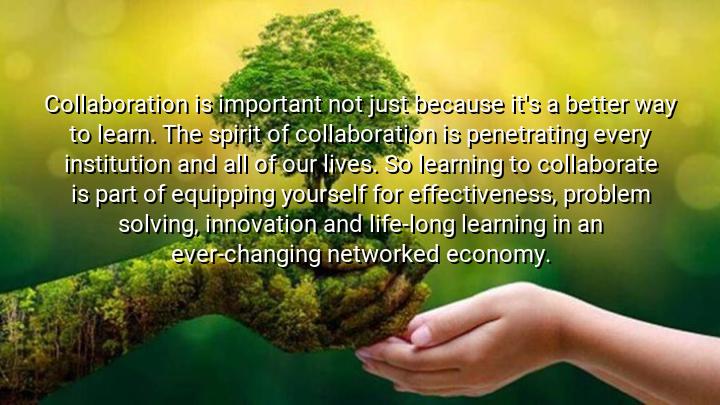




The quote “Collaboration is important not just because it's a better way to learn. The spirit of collaboration is penetrating every institution and all of our lives. So learning to collaborate is part of equipping yourself for effectiveness, problem solving, innovation and life-long learning in an ever-changing networked economy” by Don Tapscott emphasizes the central role of collaboration in modern learning, work, and personal development. Tapscott argues that collaboration is not merely a method for acquiring knowledge, but a fundamental skill necessary to thrive in increasingly connected and complex environments. By working with others, individuals develop critical thinking, creativity, and adaptability, which are essential for both personal and professional growth.
Don Tapscott, a Canadian author, consultant, and expert on technology, innovation, and the digital economy, has written extensively on how networked technologies transform organizations, education, and society. His quote reflects his broader philosophy that the future of work and learning depends on the ability to share knowledge, coordinate efforts, and innovate collectively. In Tapscott’s view, collaboration is not just a strategy—it is a cultural shift reshaping how people interact and solve problems in every domain of life.
The quote also highlights the link between collaboration and lifelong learning. Tapscott emphasizes that in an ever-changing networked economy, the capacity to collaborate effectively enables individuals to adapt, innovate, and solve problems that cannot be addressed alone. The idea of collaboration as a core competency underscores the need for continuous development of both interpersonal skills and collective intelligence, which are vital in navigating complex systems and achieving meaningful outcomes.
Ultimately, Tapscott’s statement serves as a reminder that learning to collaborate is both a practical and strategic necessity. It reinforces that effectiveness, innovation, and problem-solving in today’s world are rarely solitary endeavors. By cultivating a collaborative mindset, individuals position themselves to thrive in dynamic, networked environments, while contributing to the growth and success of the communities and organizations they are part of.

AAdministratorAdministrator
Welcome, honored guests. Please leave a comment, we will respond soon